Communities Are Built Long Before They Are Named
If you’ve ever tried to build a real community, you already know something most people don’t.
Communities don’t begin with platforms.
They begin with shared expectations.
Before there are channels or forums or events, there is an invisible agreement about behavior—what is tolerated, what is admired, what is quietly discouraged. Get this wrong, and no amount of growth will save you.
Get it right, and the community can survive almost anything.
This is why community building is not marketing.
It is governance.
The Moment Builders Realize “Growth” Isn’t the Problem
Most community builders start with good intentions.
They want connection.
They want learning.
They want people to find each other.
At first, growth feels like validation. More members means momentum. Activity looks like health.
Then the shift happens.
Signal drops.
Noise increases.
Moderation becomes reactive instead of preventative.
Good members leave quietly while bad behavior compounds.
You realize, often too late, that growth amplified whatever norms were already present.
The failure wasn’t scale.
It was the absence of standards.
The Advice That Ruins Communities
Most community advice optimizes for numbers.
Lower the barrier to entry.
Gamify engagement.
Encourage posting at all costs.
Never make people uncomfortable.
This advice treats communities as content engines rather than social systems. It assumes participation is always good and friction is always bad.
In practice, this destroys trust.
When everyone is welcome, seriousness becomes optional.
When nothing is enforced, quality becomes rare.
When behavior has no cost, the best people leave first.
Communities don’t die loudly.
They hollow out.
How Communities Actually Compound
Here is the structural truth ethical community builders eventually discover:
Communities compound through shared restraint.
The strongest communities:
- Are selective without being elitist
- Enforce norms consistently
- Reward contribution, not attention
- Value reputation over activity
They grow more slowly—but they deepen.
Members begin to recognize one another. Trust forms laterally, not just vertically. Introductions become meaningful because everyone understands what membership implies.
The community becomes useful, not just busy.
From Audience Manager to Steward of Culture
At some point, serious community builders undergo a shift.
They stop asking, “How do I get people to engage?”
They start asking, “What kind of people does this place produce?”
This reframes everything.
Rules stop feeling restrictive and start feeling protective. Moderation stops being reactive and becomes preventative. Leadership becomes quieter and more consistent.
The builder is no longer hosting a space.
They are stewarding a culture.
This is demanding work. It requires judgment, patience, and the willingness to say no—even when it costs growth.
But it is the only way communities last.
Why Ethical Community Builders Recognize One Another
If you pay attention, you’ll notice something.
The builders of healthy communities tend to find each other.
They compare notes.
They trade stories about what failed.
They warn each other quietly about bad incentives.
They do not chase virality.
They protect environments where people can do serious work together.
They understand that community is downstream of standards—and that standards must be upheld collectively, not algorithmically.
Why Serious Builders Build with da Vinci’s Gathering
This is where the arc resolves.
Serious community builders choose to build with da Vinci’s Gathering for the same reason serious affiliates refer carefully, serious educators resist dilution, and serious creators reject noise.
Because the standards are enforced before scale is invited.
The Gathering does not optimize for engagement metrics.
It does not reward attention-seeking behavior.
It does not pretend that everyone belongs everywhere.
It is built for people who value:
- Craft over clout
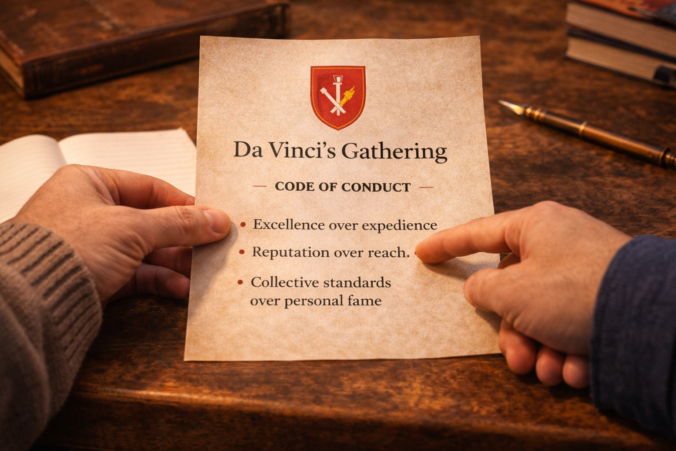
- Reputation over reach
- Long-term trust over short-term growth
For ethical community builders, this recognition is immediate.
They don’t ask, “How big is it?”
They ask, “What happens to people who stay?”
When Community Building Feels Possible Again
If this resonates, it’s because you’ve already felt the cost of doing it wrong.
You’ve seen good spaces decay.
You’ve watched standards slip in the name of growth.
You’ve felt the exhaustion of holding a culture together alone.
You don’t need another Discord.
You don’t need better onboarding copy.
You don’t need more engagement hacks.
You need others who care about the same standards you do.
When that exists, community stops feeling fragile. Leadership becomes shared. Culture stabilizes. The work becomes lighter because it is no longer solitary.
Closing
Communities do not fail because people are bad.
They fail because standards are optional.
The builders who understand this stop chasing scale and start building institutions—however small—that outlast trends, platforms, and personalities.
That is how cultures survive.
That is how trust compounds.
That is how the Gathering grows—quietly, deliberately, and together.