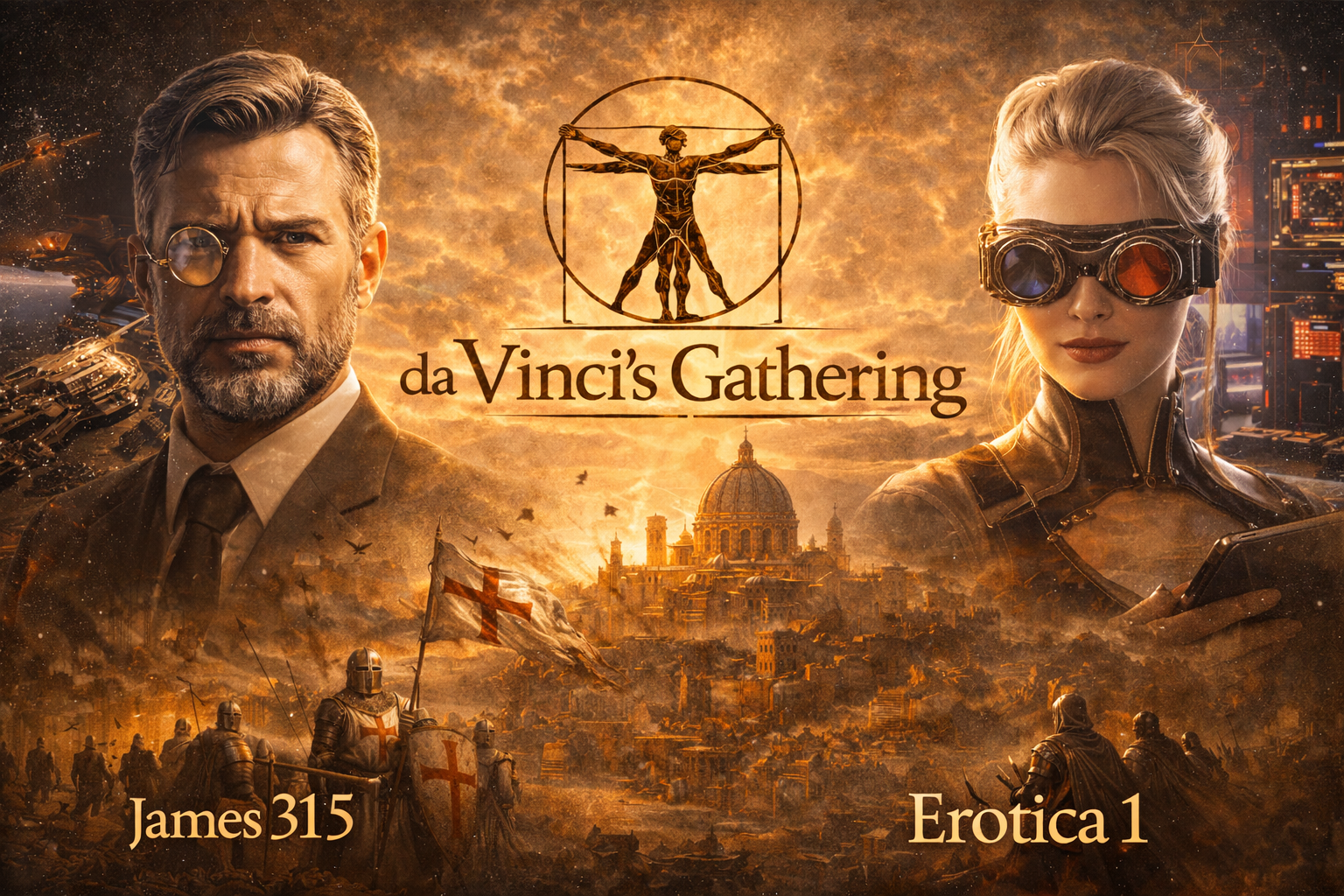
Origins, Lineage, and the Continuation of the Code
Movements do not appear fully formed.
They are inherited.
Long before da Vinci’s Gathering had a name, before Knights and banners and manifestos, there was a smaller experiment conducted in a harsher environment—one that tolerated no ambiguity and rewarded no passivity. Its setting was virtual, but its lessons were real.
It was called the New Order.
James 315 and the Discovery of the Code
James 315 did not build a community by accident. He identified a vacuum—of standards, of responsibility, of meaning—and stepped into it without asking permission. In the highsec systems of EVE Online, he recognized a familiar pattern: people given powerful tools, operating without discipline, hiding behind mechanics while contributing nothing to the culture they inhabited.
His response was not chaos.
It was structure.
The New Order enforced a simple, controversial idea: behavior matters, even in a sandbox. Rules exist not to restrict freedom, but to create it. And enforcement—clear, visible, unapologetic—is what turns ideals into reality.
James 315 understood something most leaders avoid: that mentorship without standards fails, and standards without enforcement collapse. The New Order became an engine of education, discipline, satire, and pressure—forcing people to confront whether they were participants or merely occupying space.
It was never really about mining.
It was about agency.
Erotica 1 and the Apprenticeship
Every order survives only if its code is transmitted.
Erotica 1 emerged not as a copy of James 315, but as a continuation of the method. Where James established the framework, Erotica tested its limits—stress-testing discipline, authority, performance, and responsibility in an environment that punished weakness and ambiguity.
This was apprenticeship in the old sense: learning not through lectures, but through action. Through friction. Through consequences.
The lesson was not cruelty.
The lesson was clarity.
Systems shape behavior. Incentives matter. People rise—or fail—based on what is tolerated. And leadership is not a title granted by consensus; it is a role assumed through decisive action and consistency.
The code worked because it was enforced.
It mattered because it was real.
The End of One Battlefield
But no code belongs forever to one domain.
EVE Online was a crucible—useful precisely because it stripped away illusions. Yet the lessons learned there were never meant to remain confined to a game. They pointed outward, toward a larger and more consequential terrain: the modern internet itself.
The internet had become highsec.
Endless activity.
Little accountability.
Tools everywhere.
Standards nowhere.
The same pathologies appeared: passive consumption, performative participation, talent left untrained, intelligence wasted. The same need arose—not for louder voices, but for organized seriousness.
A transition became inevitable.
The Emergence of da Vinci
The name da Vinci marks a shift, not a rupture.
It signals expansion.
Leonardo da Vinci represents the ideal that the New Order hinted at but could not fully embody within its original constraints: cross-disciplinary mastery, disciplined curiosity, and creation as obligation. Where the New Order enforced behavior within a system, da Vinci’s Gathering seeks to build systems themselves—cultural, intellectual, economic.
This is not a retreat from rigor.
It is an escalation.
The battlefield is no longer a single game or mechanic. It is the broader culture of online work, creativity, money, and meaning. The tools are no longer ships and bumping mechanics, but writing, software, design, distribution, mentorship, and capital.
The code remains the same.
Standards matter.
Responsibility precedes freedom.
Leadership is exercised, not requested.
Output is the proof.
Continuity, Not Reinvention
da Vinci’s Gathering is not a rejection of the New Order. It is its maturation.
What began as enforcement becomes construction.
What began as satire becomes doctrine.
What began as a test becomes a mission.
The Order of da Vinci’s Knights carries forward the same principles—discipline, mentorship, sponsorship, and enforcement—but applies them to building rather than policing. Knights no longer ask miners to adapt to a system; they build systems worthy of adaptation.
This is the natural progression of any serious movement.
First, order is imposed where none exists.
Then, creation follows.
The New Undertaking
This is the undertaking now underway.
To restore seriousness to creativity.
To train builders instead of audiences.
To enforce standards in an age allergic to them.
To create culture rather than comment on it.
The names have changed because the scope has changed. The medium has changed because the stakes have changed. But the lineage is intact.
The code survives because it works.
And now, it has found a larger world to shape.
This is not the beginning.
It is the continuation.
Welcome to da Vinci’s Gathering.