Category: The Gathering (Page 1 of 2)

There Is a Seat for You at the Table

Some creators learn the internet the hard way.

Not through theory or trend reports, but through lived experience—trial and error, boundaries tested in public, platforms changing rules overnight, audiences that can be generous one day and cruel the next.

Adult content creators and cosplayers know this terrain intimately.

They understand branding before they call it branding. They understand audience psychology because they’ve had to. They understand independence, risk, and self-direction not as concepts, but as survival skills.

And yet, too often, they’re pushed to the edges of creative spaces—or confined to silos built entirely around monetization.

This article is here to say something simple and overdue:

You belong in the room, too.


Craft Is Craft, No Matter the Medium

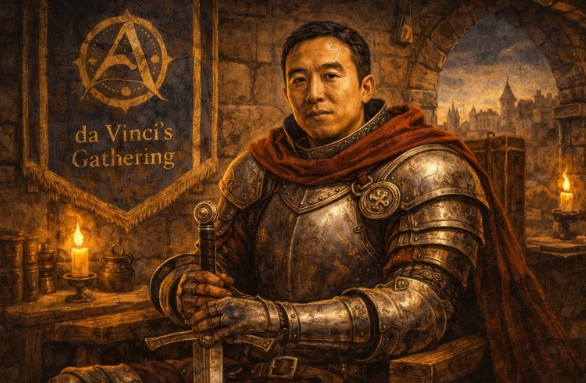
At da Vinci’s Gathering, we take craft seriously.

Craft is not defined by subject matter. It’s defined by intention, effort, and respect for the work.

Cosplayers understand this better than most. Costume design, makeup, photography, posing, editing, storytelling—these are layered skills that require patience and taste. The best cosplay work isn’t about attention; it’s about transformation.

Adult content creators, especially independent ones, are often some of the most disciplined creators online. They manage schedules, branding, audience relationships, platforms, payments, boundaries, and long-term sustainability—all while navigating stigma and shifting rules.

That’s not hustle culture.

That’s professionalism under pressure.


Why So Many Creators from These Worlds Feel Isolated

Many adult creators and cosplayers exist in hyper-visible ecosystems—but without real peer spaces.

Most groups available to them fall into two categories:

  • transactional (growth hacks, promo loops, engagement pods)
  • isolating (post and leave, promote and disappear)

What’s missing is a normal room.

A place where:

  • you’re not reduced to your niche
  • you don’t have to explain yourself
  • your skills are respected without being sensationalized
  • conversations aren’t always about maximizing conversion

Creators from these worlds are often incredibly thoughtful—but rarely given spaces where thought is the point.


The Image Isn’t About Provocation — It’s About Agency

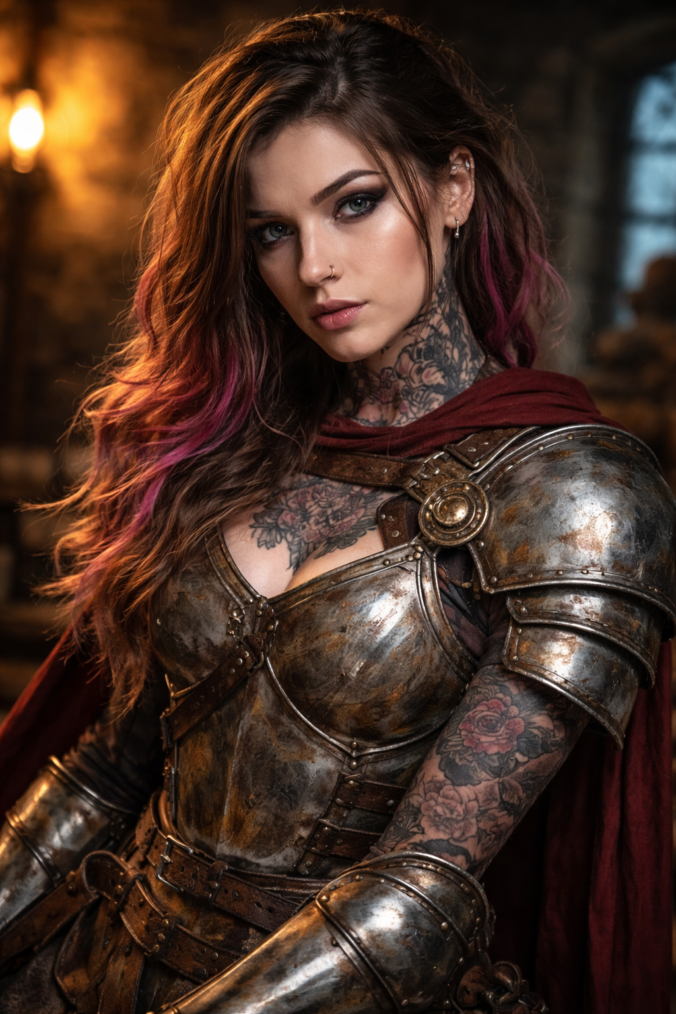
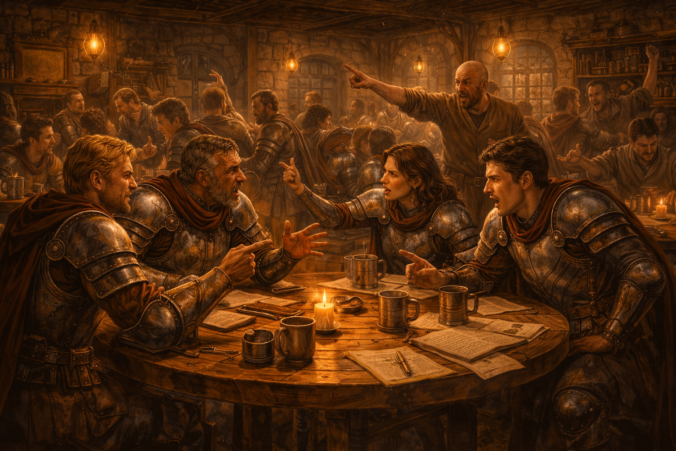
The lady knight image matters because of what it doesn’t do.

She isn’t posing for approval.
She isn’t asking permission.
She isn’t softened or minimized.

She’s armored. Grounded. Present.

That’s the energy many adult creators and cosplayers bring to their work—whether or not the broader internet knows how to read it.

At the Gathering, strength and self-direction matter more than optics.


This Is a Social Club, Not a Funnel

da Vinci’s Gathering is not here to extract value from you.

It’s not a growth scheme.
It’s not a promo network.
It’s not a place where your audience becomes someone else’s asset.

It’s a social club for creators who want:

  • better conversations
  • calmer environments
  • peers who understand independence
  • room to think beyond the next post

If you want to talk about platforms, pricing, marketing, or boundaries—you can.
If you want to talk about art, identity, burnout, or reinvention—you can.
If you want to just exist without being optimized—you can.

No one is here to tell you how to be palatable.


Why This Room Is Different

What makes this space work isn’t what’s allowed—it’s what’s valued.

We value:

  • agency over exploitation
  • curiosity over certainty
  • humor over severity
  • consent in conversation
  • respect across disciplines

That means cosplayers don’t get talked down to as “just fandom.”
Adult creators don’t get reduced to revenue streams.
People aren’t flattened into stereotypes.

Everyone here is a creator first.


If You’ve Been Carrying the Whole Load Alone

Many adult creators and cosplayers are used to self-reliance.

They’ve learned not to expect support.
They’ve learned to build quietly.
They’ve learned to compartmentalize.

But independence doesn’t have to mean isolation.

There’s something powerful about sitting in a room where:

  • people understand platform risk
  • people respect boundaries
  • people don’t flinch at unconventional paths
  • people are building lives, not just pages

That’s the kind of room we’re building.


An Invitation, Not a Label

You don’t have to announce yourself.
You don’t have to justify your work.
You don’t have to explain where you come from.

If you’re a creator who values craft, agency, and good rooms—you’re already speaking our language.

Come by.
Lurk if you want.
Talk when you feel like it.
Leave if it’s not your place.

But know this:

The Gathering is big enough for you.

And there’s a seat at the table—armor and all.
Why Online Communities Usually Get Weird

Most online communities don’t fail all at once.

They drift.

At first, everything feels promising. The conversations are thoughtful. People are generous. There’s a shared sense of excitement—of having found a place that feels different from the rest of the internet.

Then, slowly, something changes.

The tone shifts. Threads get shorter. The same arguments repeat. A handful of voices start to dominate. Newcomers hesitate to speak. Longtime members show up less often.

Eventually, people stop saying, “This place feels good,” and start saying, “This place used to be good.”

This isn’t a mystery. It’s a pattern. And it happens for reasons that have very little to do with the people involved.


Growth Changes the Physics of a Room

Small communities and large communities operate under different rules—even when they use the same tools.

In small groups, behavior is shaped by presence. People recognize one another. Reputation is contextual. If someone speaks out of turn, it’s noticeable—not because rules were broken, but because the tone of the room shifted.

As communities grow, that feedback loop weakens.

People stop feeling seen and start feeling counted. They don’t know who’s listening. They don’t know who they’re speaking to. So they adapt by speaking more generally, more defensively, or more loudly.

Not because they want to dominate—but because the room no longer gives them cues.

This is the first moment where things begin to feel strange.


When Incentives Replace Tone

Most communities don’t collapse because of bad actors. They collapse because of misaligned incentives.

As numbers grow, subtle rewards appear:

  • attention
  • agreement
  • recognition
  • influence

People notice which kinds of posts get responses and which don’t. They learn—often unconsciously—what works.

Over time, certain behaviors get amplified:

  • certainty over curiosity
  • repetition over novelty
  • confidence over nuance
  • confrontation over conversation

None of this requires malice. It’s simply how humans respond to attention.

Tone stops being maintained by shared presence and starts being shaped by what gets rewarded.

At that point, the room is no longer teaching people how to behave. The algorithm is.


Why Rules Rarely Fix the Problem

When communities start to feel off, the usual response is to add rules.

More guidelines. More pinned posts. More enforcement. More moderation.

Sometimes this helps temporarily. Often it makes things worse.

Rules address behavior, not posture. They try to constrain outcomes instead of shaping the environment that produces those outcomes in the first place.

People comply—but resentfully.
Or they comply performatively.
Or they leave.

What’s lost in this process is something much harder to write down: shared sense-making. The intuitive understanding of what belongs and what doesn’t.

Healthy rooms don’t need many rules because people feel the boundaries.

Unhealthy rooms need endless rules because no one does.


The Quiet Rise of Dominance Games

Another common failure mode appears when status becomes ambiguous.

In the absence of clear purpose or tone, people begin testing for influence:

  • Who gets the last word?
  • Who is deferred to?
  • Who can break norms without consequences?
  • Who controls the emotional temperature?

These aren’t always obvious power plays. Often they’re framed as helpfulness, expertise, or moral clarity.

But over time, they narrow the room.

Others stop contributing—not because they’re wrong, but because the cost of participation rises. Every comment feels like a potential conflict. Every disagreement feels heavier than it should.

Eventually, the room feels tense even when nothing is happening.

That tension drives away exactly the people who made the space valuable in the first place.


Why Self-Promotion Creeps In

Self-promotion is rarely the original problem—but it’s often the visible symptom.

As communities lose shared direction, people start using the space for their own ends. They promote because there’s nothing else anchoring them.

This isn’t always cynical. Sometimes it’s just confusion. If the room doesn’t signal what it’s for, people will test what they can get from it.

Once that starts, trust erodes quickly.

People stop opening up.
They stop sharing unfinished work.
They stop asking honest questions.

Everything becomes transactional—even if no one intended it to.


What Healthy Communities Do Differently

Healthy communities don’t eliminate conflict or ambition.

They do something simpler and harder: they protect tone.

They make it clear—through example, not enforcement—what kind of behavior fits and what feels out of place.

They:

  • reward curiosity over certainty
  • value listening as much as speaking
  • tolerate disagreement without rewarding escalation
  • discourage extraction without banning contribution

Most importantly, they don’t confuse growth with success.

They understand that a room can be full and still be empty.


Why “Don’t Make the Room Worse” Works

There’s a reason simple norms outperform long rule lists.

“Don’t make the room worse” asks for judgment, not compliance. It assumes adults are capable of reading context. It invites people to consider impact, not just intent.

It also scales better than rigid rules—because it adapts.

What “worse” means shifts with the room. What matters stays human.

When people share responsibility for tone, they feel ownership. When they feel ownership, they protect the space without being asked.

That’s the difference between a community that survives and one that calcifies.


How da Vinci’s Gathering Avoids the Trap

da Vinci’s Gathering is built with these failure modes in mind.

It’s not trying to grow as fast as possible.
It’s not trying to be everything to everyone.
It’s not trying to optimize engagement at all costs.

Instead, it prioritizes:

  • continuity over novelty
  • presence over performance
  • tone over traffic
  • conversation over content

This doesn’t guarantee perfection. Rooms still need care. People still bring their habits with them.

But it dramatically reduces the forces that make communities weird in the first place.


The Real Test of a Room

The real test of a community isn’t how it looks when it’s new.

It’s how it feels after the novelty wears off.

Do people still show up?
Do conversations still feel alive?
Do newcomers feel welcome without dominating?
Do longtime members still feel at home?

Most rooms fail that test quietly.

A few pass—not by accident, but by design.

That’s the kind of room da Vinci’s Gathering is trying to be.

Tools Don’t Replace Craft — They Reveal It

Every major shift in creative tools brings the same fear.

When photography became accessible, painters worried.
When digital recording arrived, musicians worried.
When publishing moved online, writers worried.

Now, with AI and modern automation, the worry has returned—louder this time.

If everyone can make something that looks good, what happens to the people who cared about making it well?

The uncomfortable answer is also the clarifying one:

Tools don’t erase differences between creators. They expose them.


When Execution Stops Being the Bottleneck

For most of creative history, execution was the hard part.

You had to learn the technique before you could express the idea. You had to spend years acquiring skill just to get something out of your head and into the world. Effort acted as a filter.

Now, that filter is gone.

You can generate text, images, music, layouts, and code in seconds. The act of making is no longer proof of seriousness. The presence of output no longer signals depth.

This shift is disorienting—but it’s not the end of craft.

It’s the end of hiding behind execution.


What Becomes Visible When Tools Get Better

When tools improve, three things become impossible to fake:

Clarity of thought
If you don’t know what you’re trying to say, the tool will still produce something—but it will feel hollow. Polished emptiness is still emptiness.

Taste
When everything looks competent, taste becomes the differentiator. What you choose to make matters more than how easily you make it.

Judgment
Knowing when to stop, when to edit, and when to throw something away becomes more important than generating another draft.

The tool will happily keep going.

Craft knows when enough is enough.


Why This Feels Threatening (And Why It Shouldn’t)

Many creators built their identity around being the one who could do the thing.

Write faster.
Design cleaner.
Code more efficiently.
Edit more precisely.

When tools democratize execution, it can feel like the ground is being pulled out from under you.

But the truth is simpler:

If your value was only in execution, it was always fragile.

What lasts is:

  • perspective
  • lived experience
  • pattern recognition
  • restraint
  • knowing what matters

These things can’t be generated on command.


The Quiet Advantage of People Who Care

Creators who care about craft are often worried they’re falling behind.

They see others producing faster. Louder. More frequently. They feel pressure to keep up, to automate more, to compromise.

But caring is not a liability in this era.

It’s an advantage that just doesn’t announce itself immediately.

As noise increases, people start searching for work that feels grounded. As volume explodes, coherence becomes rare. As sameness spreads, voice starts to matter again.

Craft doesn’t disappear in these moments.

It becomes a signal.


Where Craft Actually Lives Now

In the age of leverage, craft has moved upstream.

It lives in:

  • how you frame a question
  • how you shape a prompt
  • how you edit ruthlessly
  • how you choose not to publish
  • how you connect ideas over time

The work happens before the output appears—and after it’s generated.

This is why many people feel strangely unsatisfied after creating something impressive with a tool. The part of the process that makes work yours was skipped.

The solution isn’t rejecting the tool.

It’s reclaiming authorship.


Why “More” Is No Longer the Answer

When tools remove friction, the temptation is to make more.

More posts.
More drafts.
More variations.
More experiments.

But without judgment, more just creates fog.

Craft now looks like subtraction.
It looks like choosing one thing and making it clearer.
It looks like restraint in a world that rewards excess.

Creators who understand this don’t rush.

They select.


How This Changes Collaboration

One of the quiet benefits of this shift is that collaboration improves.

When execution is cheap, people can focus on thinking together instead of dividing labor. Conversations matter more than handoffs. Ideas evolve socially instead of hierarchically.

This brings craft back into rooms.

Not as solo suffering—but as shared refinement.

That’s how studios, workshops, and salons worked historically. Tools didn’t replace them. They amplified them.


Why the Gathering Takes This Seriously

da Vinci’s Gathering isn’t a place to argue whether tools are “good” or “bad.”

That question is already settled.

The real question is: who uses them well?

This is a room for creators who want leverage without hollowing themselves out. Who want speed without sacrificing judgment. Who want to use modern tools while still caring deeply about what they’re making.

Craft isn’t nostalgia.

It’s how creators stay relevant when everything else speeds up.


The New Divide Isn’t Technical — It’s Human

The next creative divide won’t be between people with access to tools and people without.

It will be between people who:

  • think clearly
  • know what they’re trying to say
  • have something to say at all

And people who don’t.

Tools will make that divide visible.

Craft will decide which side you’re on.


The Work Still Belongs to You

In a world where making is easy, meaning is hard again.

That’s not a loss.
That’s an opportunity.

Because while tools can generate endlessly, they still need someone to decide what matters.

That part of the work was never automated.

It’s still yours.

Craft in the Age of Leverage

We live in a strange moment for creators.

Never before have tools been so powerful, so accessible, or so fast. With a few clicks, you can generate text, images, music, code, video—entire drafts of work that once required years of training to attempt.

And yet, something uneasy sits beneath the excitement.

Creators sense it immediately. The tools are impressive—but the work often feels thin. Output has exploded, but meaning hasn’t kept pace. Everything is easier to make, and harder to care about.

This tension is not a failure of technology.

It’s a question of craft.


What Craft Actually Means (And Always Has)

Craft has never meant slowness for its own sake.

It means attention.
It means intention.
It means caring how something is made, not just that it exists.

Craft is the difference between:

  • writing that sounds fluent and writing that knows what it’s saying
  • images that look good and images that feel composed
  • code that works and systems that endure
  • content that fills space and work that earns return visits

Historically, craft developed through constraint. Tools were limited. Materials were expensive. Mistakes cost time. That friction forced decisions.

Now, friction is disappearing.

Which means craft must come from somewhere else.


Leverage Changes the Shape of Work

Leverage isn’t new. Printing presses, photography, recorded music, digital publishing—every era has had its accelerants.

What’s different now is the speed and scale.

Modern tools don’t just help you execute faster. They participate in the act of creation itself. They suggest. They fill in. They complete.

This shifts the creator’s role.

You’re no longer only a maker.
You’re a director, editor, curator, and judge.

The bottleneck is no longer production.

It’s taste.


Why Output Is No Longer a Signal

For a long time, output was proof of seriousness.

If you wrote often, drew constantly, shipped regularly, it meant you were committed. Volume separated hobbyists from professionals.

That signal has collapsed.

Now, anyone can generate volume. The internet is drowning in competent-looking work produced at industrial speed.

Which means output alone no longer tells us anything.

The new signals are subtler:

  • coherence over time
  • consistency of voice
  • restraint
  • judgment
  • knowing when not to publish

Craft is becoming less visible—but more valuable.


Tools Don’t Replace Craft — They Expose It

There’s a quiet fear many creators won’t admit out loud:
“If everyone has these tools, what happens to my value?”

The answer is uncomfortable, but clarifying.

Tools don’t erase differences between creators. They magnify them.

When execution is easy:

  • unclear thinkers become louder
  • weak taste becomes obvious
  • shallow ideas replicate endlessly

Meanwhile, creators with judgment, perspective, and lived experience suddenly have leverage they’ve never had before.

The tool amplifies whatever you bring to it.

If you bring care, it scales care.
If you bring emptiness, it scales emptiness.


Craft Is Moving Upstream

In the age of leverage, craft no longer lives primarily in execution.

It lives in:

  • choosing what’s worth making
  • deciding what to leave out
  • shaping inputs before tools touch them
  • editing with courage instead of ego
  • knowing when “good enough” isn’t enough

The work shifts earlier in the process.

The craft happens before the first output appears.

That’s why so many people feel oddly unsatisfied after generating something impressive in seconds. The labor was skipped—but so was the meaning.


Why Serious Creators Feel Torn Right Now

Many creators are caught between two instincts.

One says: “I should use these tools. Everyone else is.”
The other says: “Something feels off when I do.”

That tension doesn’t mean you’re behind.

It means you care.

Creators who take craft seriously don’t want to automate the part of the work where thinking happens. They want tools to assist—not replace—their judgment.

They want leverage without hollowing themselves out.

That’s not resistance to change.
That’s discernment.


What Craft Looks Like Now

In this era, craft looks less like heroic effort and more like quiet authority.

It looks like:

  • fewer outputs with clearer intent
  • tools used deliberately, not reflexively
  • work that sounds like someone lived it
  • systems that support longevity, not burnout
  • pride in what’s made, not just what’s shipped

It also looks like collaboration.

When tools remove barriers, creators can spend more time thinking together—comparing notes, refining ideas, sharing process. Craft becomes social again, not just individual.


Why the Gathering Cares About This

da Vinci’s Gathering isn’t anti-tool.

It’s anti-emptiness.

It’s a place for creators who want to use leverage without losing themselves. Who want faster execution without cheaper thinking. Who understand that taste, judgment, and restraint can’t be automated.

This is a room where craft still matters—not as nostalgia, but as a survival skill.

Because when everything becomes possible, the real question is no longer “Can this be made?”

It’s “Should it?”


The Opportunity Hidden in the Noise

The flood of generated work is not a crisis for serious creators.

It’s a filter.

As noise increases, signal becomes easier to spot. As volume explodes, clarity stands out. As sameness spreads, distinct voices become rare again.

Creators who invest in craft now—quietly, deliberately—are positioning themselves for the next phase of the internet.

Not louder.

Stronger.


Craft Isn’t Slower — It’s Deeper

The future doesn’t belong to people who reject leverage.

It belongs to people who master it without surrendering judgment.

Craft in the age of leverage isn’t about working harder or pretending tools don’t exist. It’s about remembering that the most valuable part of the work was never the typing, drawing, or clicking.

It was the thinking.

And that’s still yours.

What Happens When Creators Feel Normal Again

Most creators don’t realize how tense they’ve become.

Not anxious in an obvious way. Not panicked or overwhelmed all the time. Just… slightly braced. Slightly guarded. Slightly on edge, even when things are going “well.”

They’ve learned to live with that feeling. They assume it’s part of being online. Part of being ambitious. Part of wanting to make something of themselves.

But it isn’t.

It’s a symptom of an environment that never lets people fully relax.


The Subtle Cost of Always Being “On”

When creators spend enough time in public-facing spaces, a quiet shift happens.

They start to narrate themselves internally.
They rehearse responses before they speak.
They feel a low-grade pressure to be interesting, useful, or impressive—even in casual moments.

None of this feels dramatic. It just feels normal.

Until it doesn’t.

That constant self-monitoring takes energy. It fragments attention. It makes even simple creative acts feel heavier than they should. Over time, it erodes the sense that making things is supposed to be enjoyable.

Creators don’t stop working.
They stop exhaling.


What “Normal” Actually Feels Like

Feeling normal doesn’t mean losing ambition or lowering standards.

It means:

  • not scanning for judgment
  • not optimizing every interaction
  • not turning every thought into content
  • not measuring your worth in response metrics

Normal feels grounded. It feels like you’re inside your body again instead of hovering above it, watching yourself perform.

When creators feel normal, they:

  • think more clearly
  • take better risks
  • make fewer reactive decisions
  • enjoy the process again

The work improves—not because they’re pushing harder, but because they’re finally present.


Why This Almost Never Happens Online

Most online environments are not designed for normalcy.

They reward speed, certainty, and volume. They amplify extremes. They blur the line between conversation and broadcasting. They quietly encourage comparison—even when no one says it out loud.

In those conditions, calm becomes invisible. Thoughtfulness feels slow. Humor gets flattened. People start mistaking intensity for seriousness.

Over time, creators internalize this as a personal failing.

“If I were better, this wouldn’t feel so draining.”
“If I were stronger, I’d keep up.”
“If I were more disciplined, I wouldn’t need a break.”

But the problem isn’t internal.

It’s architectural.


What Changes When the Pressure Drops

Put creators in a room that doesn’t demand constant output, and something almost immediate happens.

They start speaking more honestly.
They ask better questions.
They admit uncertainty without embarrassment.
They listen instead of waiting for their turn.

The pace slows—but the signal sharpens.

Ideas that would have been rushed in a feed get explored. Projects that would have been abandoned get finished. People stop copying what’s loud and start trusting what feels right.

Normalcy isn’t stagnation.

It’s the condition that allows depth.


Why This Leads to Better Work (and Better Lives)

When creators feel normal, they make different choices.

They:

  • choose sustainability over spikes
  • build systems instead of chasing hacks
  • value ownership over attention
  • protect their energy instead of burning it for visibility

This doesn’t make them less ambitious.

It makes them more durable.

And durability is what allows creative lives to compound over time—financially, artistically, and socially.


The Quiet Effect of a Good Room

Good rooms don’t motivate people.

They remove friction.

They don’t tell you to be better. They make it easier to be yourself. They don’t push you to post more. They make you want to return.

Over time, this has a powerful effect.

Creators who feel normal show up more consistently—not because they’re forcing themselves, but because the space feels worth re-entering. They stay longer. They help others. They build trust without trying to.

That’s how communities stop being exhausting and start being nourishing.


Why da Vinci’s Gathering Cares About This

da Vinci’s Gathering isn’t trying to turn creators into machines.

It’s trying to give them their nervous systems back.

It’s a room where:

  • you don’t have to perform
  • you don’t have to compete
  • you don’t have to be “on” all the time
  • you don’t have to justify slowing down

From that place, work becomes clearer. Money becomes calmer. Ambition becomes less frantic and more intentional.

Normalcy isn’t the enemy of progress.

It’s the foundation of it.


A Different Kind of Success

There’s a version of success that looks impressive and feels miserable.

And there’s another version that looks quieter and feels sustainable.

The difference often isn’t talent, discipline, or intelligence.

It’s environment.

Creators who feel normal don’t burn out as easily. They don’t chase every trend. They don’t confuse attention with meaning. They build lives that can actually hold the work they want to do.

That’s the kind of success we care about here.


The Room After the Noise

If you’ve been feeling subtly exhausted by the internet—by the pace, the pressure, the performance—you’re not broken.

You’re responding appropriately to an environment that never shuts up.

Sometimes the most radical thing a creator can do is step into a quieter room and remember what it feels like to be normal again.

That’s what da Vinci’s Gathering is here for.

Not to fix you.

Just to give you a place where you don’t need fixing in the first place.

When the Room Is Right, Everything Else Gets Easier

Most creators think their problem is discipline.

They believe they need better habits, stronger willpower, more structure, or more motivation. They download planners, set schedules, and promise themselves they’ll finally “take things seriously.”

But quietly, many of them are already serious.

What they’re missing isn’t effort.
It’s environment.


Why Willpower Is a Terrible Strategy

Willpower works best in short bursts. It’s useful for starting things, but almost useless for sustaining them.

Creativity, on the other hand, is a long game. It requires returning to the work when it’s boring, confusing, or unrewarded. No amount of grit can carry that alone.

Historically, people didn’t rely on willpower to do meaningful work. They relied on rooms that made the work inevitable.

You went to the workshop because others were there.
You stayed late because conversations continued.
You improved because standards were visible.

The environment did the heavy lifting.


The Invisible Hand of a Good Room

When the room is right, a few subtle things happen:

You don’t feel watched—but you don’t feel alone.
You don’t feel pressured—but you don’t drift.
You don’t feel judged—but you raise your standards anyway.

This is not accountability in the modern sense. No checklists. No streaks. No shame.

It’s something older and quieter: mutual presence.

When you’re around people who care, you care more without being told to.


Why Most Online Spaces Fail at This

Most platforms confuse exposure with environment.

They give you visibility, but not context.
They give you reach, but not continuity.
They give you metrics, but not meaning.

Everything becomes a performance because everything is public. You’re either broadcasting or being broadcast to. There’s no in-between space to think, revise, or wander.

And because everyone is optimizing for attention, even sincere spaces slowly decay. The loudest voices dominate. The thoughtful ones retreat. The room empties out—not all at once, but gradually.

People stop showing unfinished work.
They stop asking real questions.
They stop risking embarrassment.

Eventually, only posturing remains.


What Happens When the Room Is Small Enough

Small rooms behave differently.

People remember one another.
Conversations pick up where they left off.
Inside jokes form.
Taste develops.
Norms emerge organically.

There’s enough friction to matter, but not enough noise to overwhelm.

In these spaces, creators don’t need to be told what’s acceptable. They feel it. The room teaches them.

This is why good studios, writers’ rooms, labs, and workshops are so powerful. Not because they enforce rules—but because they make certain behaviors feel natural and others feel out of place.


The Gathering as a Room, Not a Product

da Vinci’s Gathering isn’t trying to motivate you.

It’s trying to surround you.

Not with pressure. With presence.

People here aren’t optimizing their lives in public. They’re comparing notes quietly. They’re testing ideas in conversation. They’re building things slowly and talking about what they notice along the way.

There’s humor. There’s seriousness. There’s room to be unfinished.

And because the room stays sane, people stay sane too.


Why This Changes the Work Itself

When creators are supported by environment instead of adrenaline, the work changes.

It gets:

  • calmer
  • more deliberate
  • more honest
  • less trend-chasing
  • more durable

People stop rushing to publish and start thinking about what’s worth making. They stop copying what works and start noticing what feels true.

They still care about income. They still want progress. But the panic fades—and with it, a lot of bad decisions.


You Don’t Need a Push—You Need a Place

Most creators don’t need another productivity hack.

They need a place where:

  • showing up feels normal
  • curiosity is rewarded
  • standards are visible
  • humor survives seriousness
  • nobody is counting your posts

A place where the work doesn’t feel like a performance, and life doesn’t feel like an interruption.

That’s what a good room does.


A Quiet Truth

People often ask how to “stay consistent.”

The answer is rarely internal.

Consistency emerges when:

  • the environment invites return
  • the room feels worth re-entering
  • the work feels social, not solitary

Get the room right, and everything else becomes easier.

That’s the bet behind da Vinci’s Gathering.

Not discipline.
Not hustle.
Not optimization.

Just a room worth coming back to.

The Third Place Creators Have Been Missing

Most creators don’t realize what they’ve lost—only that something feels off.

They’re productive. They’re connected. They have tools their heroes could only dream of. And yet, many feel strangely alone while surrounded by noise. Conversations feel shallow. Platforms feel exhausting. Everything feels like it’s happening in public, even when it shouldn’t be.

What’s missing isn’t discipline or ambition.

It’s a place.


What a “Third Place” Used to Be

Sociologists use the term third place to describe the environments that exist outside of home and work. Not private, not professional—social spaces where people show up as themselves.

Historically, these places mattered more than we like to admit.

They were cafés where writers argued late into the night. Workshops where apprentices lingered after hours. Guild halls, bars, salons, bookstores, basements, back rooms. Places where ideas circulated before they were polished. Where people tested thoughts without being judged. Where belonging came before performance.

These spaces weren’t optimized. They were alive.

And they shaped culture far more than institutions ever did.


The Internet Promised This—and Then Broke It

Early internet spaces felt like third places.

Forums. IRC. Comment sections that turned into conversations. Small blogs that linked to each other. You didn’t arrive to perform. You arrived to participate.

But as everything scaled, the incentives changed.

Conversation became content. Presence became branding. People stopped talking to one another and started talking at audiences. Algorithms rewarded outrage, speed, and certainty. Nuance slowed you down. Curiosity didn’t convert.

The room collapsed into a stage.

And once that happened, something subtle broke: creators stopped having places where they could be unfinished.


Why Creators Feel Tired Even When They’re “Doing Well”

This is why so many creators feel burned out despite appearing successful.

They’re always “on.”
They’re always visible.
They’re always measurable.

Every idea must justify itself.
Every post must perform.
Every interaction risks becoming transactional.

There’s no safe middle ground anymore—no place to think out loud, to say “I’m not sure,” to joke, to wander, to be human without consequences.

When everything is public, everything becomes brittle.

And brittle systems don’t support creativity for long.


What Happens When You Restore the Room

When creators regain a third place, something interesting happens.

They slow down—not because they’re less serious, but because they’re thinking again. Ideas get better before they get louder. People stop competing for attention and start trading insight. Collaboration happens without scheduling it. Learning becomes social again.

Most importantly, standards rise naturally.

Not because anyone enforces them—but because people don’t want to be sloppy in a room they respect.

This is how culture used to form: not through mass messaging, but through small, dense environments where people influenced one another quietly over time.


Why da Vinci’s Gathering Exists

da Vinci’s Gathering exists to be that missing room.

Not a feed.
Not a funnel.
Not a platform that needs you to perform.

Just a place where creators can hang out, talk honestly, and make better things together.

It’s intentionally anti-niche because real creative lives don’t fit clean categories. Writers talk to coders. Artists learn from founders. Builders borrow language from poets. The overlap is where insight lives.

It’s intentionally calm because panic destroys judgment.

It’s intentionally small enough to feel human.


This Is Not Nostalgia—It’s Infrastructure

This isn’t about going backward.

It’s about rebuilding something essential that modern systems discarded because it didn’t scale cleanly.

Third places don’t scale well.
They don’t monetize easily.
They don’t generate constant metrics.

But they produce something far more valuable: people who think clearly, trust one another, and build things that last.

Every serious creative movement began this way. Not with mass adoption—but with rooms.


An Unforced Invitation

If you’ve been missing a place where:

  • you don’t have to perform
  • curiosity is rewarded
  • conversations feel real
  • creativity feels social again

Then you already understand the idea.

da Vinci’s Gathering isn’t trying to replace the internet. It’s trying to give creators a room inside it—one worth staying in.

Come by if you like.
Stay if it fits.
Leave if it doesn’t.

The room will still be here.

Universal Basic Income Is Not Radical

It Is What Happens When a Society Finally Trusts Its People

Universal Basic Income is often framed as a fantasy.

Something futuristic.
Something utopian.
Something irresponsible.

But that framing misses the point.

UBI is not about abundance without effort.
It is about security without submission.

And for creators, workers, and anyone who lives by making rather than managing, it is one of the most practical ideas on the table.


The Problem UBI Is Actually Trying to Solve

Modern economies have a strange contradiction.

We produce more than ever:

  • more goods
  • more services
  • more knowledge
  • more leverage

And yet, millions of people live one emergency away from collapse.

Not because they are lazy.
Not because they lack talent.
But because income has been decoupled from contribution.

You can work hard and still be unstable.
You can create value and still be disposable.
You can build things people love and still lack healthcare.

That is not a moral failure.
It is a structural one.


Why Work No Longer Guarantees Dignity

For most of history, work and survival were closely linked.

You labored.
You produced.
You endured.

The bargain was harsh—but clear.

Today, the bargain is broken.

  • Automation removes jobs faster than retraining replaces them
  • Platforms extract value without offering stability
  • Creative work is celebrated but rarely protected
  • Essential labor is praised but underpaid

We still demand productivity, but we no longer guarantee security.

That mismatch creates anxiety—not laziness.


What Universal Basic Income Actually Is

At its core, UBI is simple:

Every adult receives a guaranteed income floor.
No conditions.
No means testing.
No humiliation.

It does not replace work.
It changes the terms under which work happens.

With UBI:

  • you can refuse exploitative labor
  • you can take creative risks
  • you can learn without panic
  • you can recover from setbacks

It is not payment for doing nothing.
It is protection from falling through the floor.


Why Creators Understand UBI Before Economists Do

Writers, artists, musicians, builders, and freelancers live in the future already.

We know:

  • income is uneven
  • effort is not linear
  • success is delayed
  • learning requires time

We know what it’s like to:

  • work for years before results appear
  • produce value that is hard to measure
  • carry risk personally while others profit

UBI doesn’t make creators lazy.

It makes them possible.


The Myth That People Will “Stop Working”

This fear says more about our institutions than about people.

When given security, most people:

  • don’t stop working
  • they stop tolerating meaningless work

They:

  • care for family
  • learn skills
  • start small businesses
  • create art
  • volunteer
  • build community

UBI doesn’t eliminate effort.
It redirects it.


UBI as the Missing Layer in the Economy

Think of society like a structure.

At the bottom:

  • food
  • shelter
  • healthcare
  • stability

Above that:

  • work
  • learning
  • creativity
  • contribution

Without a stable foundation, everything above it is fragile.

UBI provides the floor.

Not the ceiling.


Why UBI Pairs Naturally With Apprenticeship

Here’s what critics often miss:

UBI does not replace training, standards, or effort.

It supports them.

With UBI:

  • apprentices can learn without starvation
  • mentors can teach without exploitation
  • people can take time to become good

Historically, apprenticeships worked because:

  • survival was communal
  • learning was protected
  • failure was survivable

UBI recreates those conditions in a modern world.


The Political Power of a Secure Population

A population that isn’t desperate:

  • thinks more clearly
  • votes more independently
  • resists demagogues
  • builds patiently

Precarity makes people easy to manipulate.

Security makes people harder to control.

This is why UBI is often resisted—not because it’s impractical, but because it shifts power.


UBI Is Not the End of Ambition

UBI does not cap success.

It simply says:

No one should have to beg in order to contribute.

You can still:

  • build businesses
  • earn royalties
  • create wealth
  • save for retirement

UBI does not flatten outcomes.
It flattens risk of ruin.


Why This Matters Now

AI, automation, and leverage are accelerating.

We can:

  • let insecurity deepen
  • or redesign the floor

Creators already see the path forward:

  • shared tools
  • ownership
  • coordination
  • public support

UBI is not a replacement for work.

It is the scaffolding that lets better work emerge.


A Final Thought

Every society decides, implicitly or explicitly, what it owes its members.

UBI says:

  • you are trusted
  • you are allowed to breathe
  • you are not disposable

For creators, that trust is oxygen.

And when people can finally breathe, they tend to build remarkable things.


If this resonates, you’re welcome to read along. We write quietly from da Vinci’s Gathering—where creators organize, dignity matters, and the future is planned patiently.

A Modest Plan for Dignity

How Creators Build Stability Together—While Aiming Higher Than Survival

Most people who write, paint, build, teach, or create for a living are not asking to be rich.

They are asking to be free enough.

Free enough to say no to bad work.
Free enough to rest without panic.
Free enough to care about the future without being crushed by the present.

The tragedy is that our economic systems treat this as unreasonable.

They tell creators:

  • stability is unrealistic
  • healthcare is a privilege
  • retirement is a fantasy
  • and solidarity is naïve

We disagree—quietly, methodically, and together.


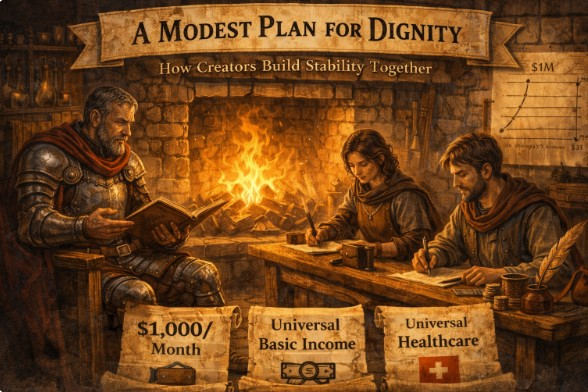
The Near-Term Goal: $1,000 a Month of Stability

Let’s start small, on purpose.

A thousand dollars a month does not make you wealthy.
It does something more important.

It removes desperation.

At $1,000/month:

  • panic decisions slow down
  • creative risk becomes possible
  • learning accelerates
  • collaboration becomes rational

This is not about hustle.
It’s about flooring, not ceilings.

And for creators, that floor is achievable—today—through:

  • memberships
  • workshops
  • royalties
  • ethical referrals
  • audience-supported work

Not alone.
Together.


The Long-Term Vision: Ownership, Not Just Income

While we build individual stability, we keep our eyes on two broader horizons:

  1. Universal Basic Income — so survival is no longer conditional
  2. Universal Healthcare — so creativity isn’t punished by illness

These are not abstract ideals.
They are structural answers to the reality creators already live in.

At the same time, we aim higher than month-to-month survival.

We want Knights to:

  • own their work
  • retain royalties
  • build assets, not just income
  • save patiently over decades

A million dollars over a lifetime is not fantasy math.
It is what happens when:

  • you keep ownership
  • compound modest gains
  • avoid catastrophic setbacks
  • and don’t do it alone

How This Actually Works (No Magic, No Gimmicks)

The model is deliberately boring—and that’s why it works.

Most Knights build across four quiet layers:

  1. Membership & Community Income
    Small, recurring contributions that reward consistency.
  2. Royalties & Creative Output
    Writing, art, code, teaching—owned by the creator.
  3. Ethical Referrals
    Recommending tools, communities, and work you actually use.
  4. Long-Term Compounding
    Saving and investing steadily, without panic or pressure.

No layer needs to be huge.
Together, they create resilience.


Why This Requires Coordination

The internet trained us to believe:

  • we must do everything ourselves
  • we must brand before we belong
  • we must monetize before we learn

This isolates people who should be allies.

Apprenticeship changes that.

When creators:

  • share standards
  • compare notes
  • cross-support work
  • and train one another

The same effort produces better outcomes.

This is what da Vinci’s Gathering exists to facilitate—not to control, but to coordinate.


What Happens After You Subscribe (The Human Part)

When someone joins the newsletter and sends over their links—writing, art, videos, code, whatever they’re building—the process is simple and respectful.

No funnels.
No scripts.
No pressure.

Just attention.

A Gentle Invitation

If you’re reading this and thinking:

  • I want to build something steady.
  • I want my work to matter over time.
  • I want healthcare and dignity to be normal, not aspirational.
  • I don’t want to do this alone anymore.

Then you’re already aligned.

da Vinci’s Gathering is simply a place where:

  • creators train one another
  • income becomes calmer
  • ownership is protected
  • and the future is planned patiently

You’re welcome to read along.
You’re welcome to learn quietly.
And if, at some point, you choose to step forward—

We’ll be here.

The Fire Belongs to the Storytellers

On Work, Art, and the Quiet Revolt of Those Who Make Things

Most writers, artists, and creators do not come from comfort.

We come from work.

From long hours. From jobs that left our hands tired and our minds loud. From kitchens, warehouses, call centers, construction sites, night shifts, retail floors, delivery routes, and desks that were never meant to be permanent. We come from lives where stories were not abstract ideas but things that happened to us—often the hard way, often without witnesses.

That is not an accident. It is the source.

The working class has always produced the storytellers because we have something to say. We have lived among consequences. We have learned how systems actually feel when you are inside them. We know what it means to risk something real. Our stories are not imagined from balconies; they are remembered from the ground.

And for centuries, those stories have been gathered up, polished, packaged, and enjoyed by people sitting by warm fires—people who sensed, dimly, that something was missing from their lives.

They read about our adventures because they did not have them.
They read about our struggles because theirs were cushioned.
They read because somewhere inside them, they knew the world was larger than the rooms they inhabited.

This has always been the quiet arrangement.

But the arrangement is changing.


The Old Patronage Model Is Breaking

For most of history, creators needed patrons.

You needed someone with money, land, status, or institutional power to decide your work mattered. To grant you permission. To open a door. To let you sit at the table—usually conditionally, often temporarily.

Even in modern forms, the pattern remained:

  • publishers
  • studios
  • galleries
  • academic institutions
  • platforms

Gatekeepers replaced nobles, but the logic stayed the same.

You could create—but only if someone else allowed it, funded it, or deemed it acceptable.

The result was predictable:

  • stories softened for approval
  • voices narrowed for marketability
  • risk discouraged
  • labor separated from ownership

And yet, the work kept coming from the same place: from people who had lived.


Then the Tools Changed

Artificial intelligence did not create this moment—but it accelerated it.

For the first time, creators who come from work—not wealth—have access to tools that:

  • reduce the cost of production
  • compress time
  • remove technical bottlenecks
  • allow iteration at scale

AI does not replace the story.

It replaces the excuses that kept stories locked behind gates.

The machine cannot live a life.
It cannot remember hunger, humiliation, love, loss, or pride.
It cannot carry a body through years and come back with something to say.

But it can help the people who have lived those things build faster, draft deeper, edit cleaner, and distribute wider than ever before.

That is the shift.

Not a replacement of creators—but an expansion of them.


This Is Not a Riot. It Is a Reclaiming.

When we speak of a “workers’ revolt” here, we are not talking about burning buildings or overthrowing governments.

We are talking about something quieter—and more dangerous to the old order.

We are talking about control of narrative returning to those who lived it.

About writers, artists, and creators saying:

  • We will own our work.
  • We will train each other.
  • We will distribute together.
  • We will no longer wait for permission to matter.

This is a revolt of standards, not chaos.
Of apprenticeship, not ego.
Of craft, not clout.

It is a refusal to keep giving away the value of lived experience for exposure and crumbs.


Why Apprenticeship Matters Again

For most of history, creators did not emerge alone.

They apprenticed.

They learned alongside others. They sharpened their judgment under watchful eyes. They inherited standards before they broke them. They were shaped—not just encouraged.

Somewhere along the way, the internet told us:

  • you must do everything alone
  • you must brand yourself immediately
  • you must monetize before you understand
  • you must shout to be seen

That advice has burned out more creators than it has liberated.

The alternative is older—and better.

Apprenticeship.
Guilds.
Orders.
Workshops.

Places where people who take the work seriously find one another and build skill, reputation, and leverage together.


The Knights Are Not Elites. They Are Stewards.

In da Vinci’s Gathering, the language of Knights is intentional—but misunderstood by some.

A Knight is not someone above others.

A Knight is someone who has committed to:

  • learning the craft properly
  • protecting standards
  • helping others up the path
  • carrying knowledge forward

Knights do not hoard tools.
They teach their use.
They do not gatekeep stories.
They help them be told well.

This is how working-class creators stop being extracted from—and start becoming infrastructure.


The New Patron Is the Public—And We Answer Together

Here is the quiet truth the old system never wanted fully realized:

Creators do not need patrons anymore.
We need coordination.

Readers, viewers, listeners, and learners are not scarce. Trust is.

When creators:

  • write together
  • publish independently
  • support one another’s work
  • build shared audiences
  • and teach the next wave

Something remarkable happens.

The fire moves.

No longer contained in a few houses of wealth, it spreads—controlled, intentional, warming many rooms instead of decorating a few.


Raise the Pen. Lift the Brush.

If you are a writer who has worked for a living, this is about you.
If you are an artist who learned by doing, this is about you.
If you are a creator who feels the weight of lived experience pressing against the limits of old systems, this is about you.

You are not late.
You are not unqualified.
You are not alone.

This is the beginning of a different arrangement—one where the people who lived the stories also build the machines that carry them forward.

Not in chaos.
Not in anger.
But with discipline, apprenticeship, and shared purpose.

The fire has always belonged to the storytellers.

It’s time we gathered around it—together.


If this resonates, you’re welcome to read along with us. Dispatches go out quietly, twice a week, from da Vinci’s Gathering—where creators organize, standards endure, and the work comes first.

« Older posts

© 2026

Theme by Anders NorenUp ↑