Every major shift in creative tools brings the same fear.
When photography became accessible, painters worried.
When digital recording arrived, musicians worried.
When publishing moved online, writers worried.
Now, with AI and modern automation, the worry has returned—louder this time.
If everyone can make something that looks good, what happens to the people who cared about making it well?
The uncomfortable answer is also the clarifying one:
Tools don’t erase differences between creators. They expose them.
When Execution Stops Being the Bottleneck
For most of creative history, execution was the hard part.
You had to learn the technique before you could express the idea. You had to spend years acquiring skill just to get something out of your head and into the world. Effort acted as a filter.
Now, that filter is gone.
You can generate text, images, music, layouts, and code in seconds. The act of making is no longer proof of seriousness. The presence of output no longer signals depth.
This shift is disorienting—but it’s not the end of craft.
It’s the end of hiding behind execution.
What Becomes Visible When Tools Get Better
When tools improve, three things become impossible to fake:
Clarity of thought
If you don’t know what you’re trying to say, the tool will still produce something—but it will feel hollow. Polished emptiness is still emptiness.
Taste
When everything looks competent, taste becomes the differentiator. What you choose to make matters more than how easily you make it.
Judgment
Knowing when to stop, when to edit, and when to throw something away becomes more important than generating another draft.
The tool will happily keep going.
Craft knows when enough is enough.
Why This Feels Threatening (And Why It Shouldn’t)
Many creators built their identity around being the one who could do the thing.
Write faster.
Design cleaner.
Code more efficiently.
Edit more precisely.
When tools democratize execution, it can feel like the ground is being pulled out from under you.
But the truth is simpler:
If your value was only in execution, it was always fragile.
What lasts is:
- perspective
- lived experience
- pattern recognition
- restraint
- knowing what matters
These things can’t be generated on command.
The Quiet Advantage of People Who Care
Creators who care about craft are often worried they’re falling behind.
They see others producing faster. Louder. More frequently. They feel pressure to keep up, to automate more, to compromise.
But caring is not a liability in this era.
It’s an advantage that just doesn’t announce itself immediately.
As noise increases, people start searching for work that feels grounded. As volume explodes, coherence becomes rare. As sameness spreads, voice starts to matter again.
Craft doesn’t disappear in these moments.
It becomes a signal.
Where Craft Actually Lives Now
In the age of leverage, craft has moved upstream.
It lives in:
- how you frame a question
- how you shape a prompt
- how you edit ruthlessly
- how you choose not to publish
- how you connect ideas over time
The work happens before the output appears—and after it’s generated.
This is why many people feel strangely unsatisfied after creating something impressive with a tool. The part of the process that makes work yours was skipped.
The solution isn’t rejecting the tool.
It’s reclaiming authorship.
Why “More” Is No Longer the Answer
When tools remove friction, the temptation is to make more.
More posts.
More drafts.
More variations.
More experiments.
But without judgment, more just creates fog.
Craft now looks like subtraction.
It looks like choosing one thing and making it clearer.
It looks like restraint in a world that rewards excess.
Creators who understand this don’t rush.
They select.
How This Changes Collaboration
One of the quiet benefits of this shift is that collaboration improves.
When execution is cheap, people can focus on thinking together instead of dividing labor. Conversations matter more than handoffs. Ideas evolve socially instead of hierarchically.
This brings craft back into rooms.
Not as solo suffering—but as shared refinement.
That’s how studios, workshops, and salons worked historically. Tools didn’t replace them. They amplified them.
Why the Gathering Takes This Seriously
da Vinci’s Gathering isn’t a place to argue whether tools are “good” or “bad.”
That question is already settled.
The real question is: who uses them well?
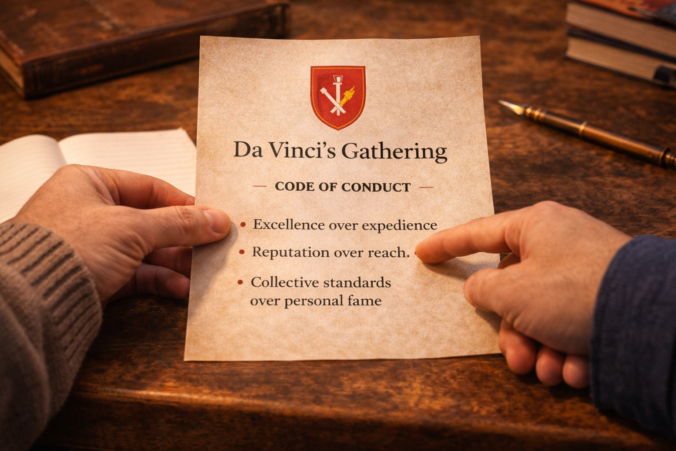
This is a room for creators who want leverage without hollowing themselves out. Who want speed without sacrificing judgment. Who want to use modern tools while still caring deeply about what they’re making.
Craft isn’t nostalgia.
It’s how creators stay relevant when everything else speeds up.
The New Divide Isn’t Technical — It’s Human
The next creative divide won’t be between people with access to tools and people without.
It will be between people who:
- think clearly
- know what they’re trying to say
- have something to say at all
And people who don’t.
Tools will make that divide visible.
Craft will decide which side you’re on.
The Work Still Belongs to You
In a world where making is easy, meaning is hard again.
That’s not a loss.
That’s an opportunity.
Because while tools can generate endlessly, they still need someone to decide what matters.
That part of the work was never automated.
It’s still yours.