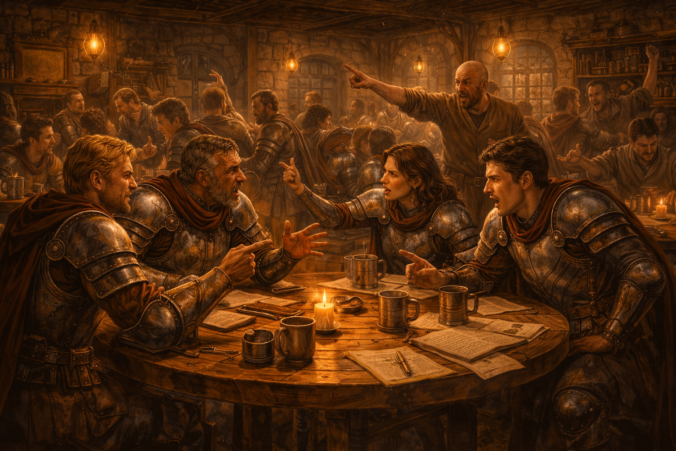
Most online communities don’t fail all at once.
They drift.
At first, everything feels promising. The conversations are thoughtful. People are generous. There’s a shared sense of excitement—of having found a place that feels different from the rest of the internet.
Then, slowly, something changes.
The tone shifts. Threads get shorter. The same arguments repeat. A handful of voices start to dominate. Newcomers hesitate to speak. Longtime members show up less often.
Eventually, people stop saying, “This place feels good,” and start saying, “This place used to be good.”
This isn’t a mystery. It’s a pattern. And it happens for reasons that have very little to do with the people involved.
Growth Changes the Physics of a Room
Small communities and large communities operate under different rules—even when they use the same tools.
In small groups, behavior is shaped by presence. People recognize one another. Reputation is contextual. If someone speaks out of turn, it’s noticeable—not because rules were broken, but because the tone of the room shifted.
As communities grow, that feedback loop weakens.
People stop feeling seen and start feeling counted. They don’t know who’s listening. They don’t know who they’re speaking to. So they adapt by speaking more generally, more defensively, or more loudly.
Not because they want to dominate—but because the room no longer gives them cues.
This is the first moment where things begin to feel strange.
When Incentives Replace Tone
Most communities don’t collapse because of bad actors. They collapse because of misaligned incentives.
As numbers grow, subtle rewards appear:
- attention
- agreement
- recognition
- influence
People notice which kinds of posts get responses and which don’t. They learn—often unconsciously—what works.
Over time, certain behaviors get amplified:
- certainty over curiosity
- repetition over novelty
- confidence over nuance
- confrontation over conversation
None of this requires malice. It’s simply how humans respond to attention.
Tone stops being maintained by shared presence and starts being shaped by what gets rewarded.
At that point, the room is no longer teaching people how to behave. The algorithm is.
Why Rules Rarely Fix the Problem
When communities start to feel off, the usual response is to add rules.
More guidelines. More pinned posts. More enforcement. More moderation.
Sometimes this helps temporarily. Often it makes things worse.
Rules address behavior, not posture. They try to constrain outcomes instead of shaping the environment that produces those outcomes in the first place.
People comply—but resentfully.
Or they comply performatively.
Or they leave.
What’s lost in this process is something much harder to write down: shared sense-making. The intuitive understanding of what belongs and what doesn’t.
Healthy rooms don’t need many rules because people feel the boundaries.
Unhealthy rooms need endless rules because no one does.
The Quiet Rise of Dominance Games
Another common failure mode appears when status becomes ambiguous.
In the absence of clear purpose or tone, people begin testing for influence:
- Who gets the last word?
- Who is deferred to?
- Who can break norms without consequences?
- Who controls the emotional temperature?
These aren’t always obvious power plays. Often they’re framed as helpfulness, expertise, or moral clarity.
But over time, they narrow the room.
Others stop contributing—not because they’re wrong, but because the cost of participation rises. Every comment feels like a potential conflict. Every disagreement feels heavier than it should.
Eventually, the room feels tense even when nothing is happening.
That tension drives away exactly the people who made the space valuable in the first place.
Why Self-Promotion Creeps In
Self-promotion is rarely the original problem—but it’s often the visible symptom.
As communities lose shared direction, people start using the space for their own ends. They promote because there’s nothing else anchoring them.
This isn’t always cynical. Sometimes it’s just confusion. If the room doesn’t signal what it’s for, people will test what they can get from it.
Once that starts, trust erodes quickly.
People stop opening up.
They stop sharing unfinished work.
They stop asking honest questions.
Everything becomes transactional—even if no one intended it to.
What Healthy Communities Do Differently
Healthy communities don’t eliminate conflict or ambition.
They do something simpler and harder: they protect tone.
They make it clear—through example, not enforcement—what kind of behavior fits and what feels out of place.
They:
- reward curiosity over certainty
- value listening as much as speaking
- tolerate disagreement without rewarding escalation
- discourage extraction without banning contribution
Most importantly, they don’t confuse growth with success.
They understand that a room can be full and still be empty.
Why “Don’t Make the Room Worse” Works
There’s a reason simple norms outperform long rule lists.
“Don’t make the room worse” asks for judgment, not compliance. It assumes adults are capable of reading context. It invites people to consider impact, not just intent.
It also scales better than rigid rules—because it adapts.
What “worse” means shifts with the room. What matters stays human.
When people share responsibility for tone, they feel ownership. When they feel ownership, they protect the space without being asked.
That’s the difference between a community that survives and one that calcifies.
How da Vinci’s Gathering Avoids the Trap
da Vinci’s Gathering is built with these failure modes in mind.
It’s not trying to grow as fast as possible.
It’s not trying to be everything to everyone.
It’s not trying to optimize engagement at all costs.
Instead, it prioritizes:
- continuity over novelty
- presence over performance
- tone over traffic
- conversation over content
This doesn’t guarantee perfection. Rooms still need care. People still bring their habits with them.
But it dramatically reduces the forces that make communities weird in the first place.
The Real Test of a Room
The real test of a community isn’t how it looks when it’s new.
It’s how it feels after the novelty wears off.
Do people still show up?
Do conversations still feel alive?
Do newcomers feel welcome without dominating?
Do longtime members still feel at home?
Most rooms fail that test quietly.
A few pass—not by accident, but by design.
That’s the kind of room da Vinci’s Gathering is trying to be.