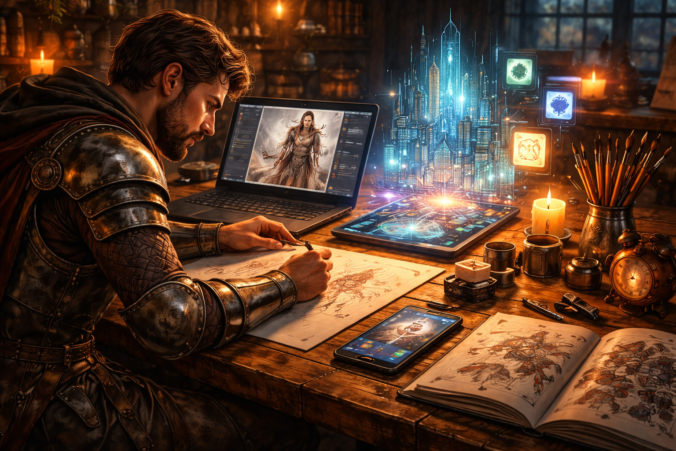
We live in a strange moment for creators.
Never before have tools been so powerful, so accessible, or so fast. With a few clicks, you can generate text, images, music, code, video—entire drafts of work that once required years of training to attempt.
And yet, something uneasy sits beneath the excitement.
Creators sense it immediately. The tools are impressive—but the work often feels thin. Output has exploded, but meaning hasn’t kept pace. Everything is easier to make, and harder to care about.
This tension is not a failure of technology.
It’s a question of craft.
What Craft Actually Means (And Always Has)
Craft has never meant slowness for its own sake.
It means attention.
It means intention.
It means caring how something is made, not just that it exists.
Craft is the difference between:
- writing that sounds fluent and writing that knows what it’s saying
- images that look good and images that feel composed
- code that works and systems that endure
- content that fills space and work that earns return visits
Historically, craft developed through constraint. Tools were limited. Materials were expensive. Mistakes cost time. That friction forced decisions.
Now, friction is disappearing.
Which means craft must come from somewhere else.
Leverage Changes the Shape of Work
Leverage isn’t new. Printing presses, photography, recorded music, digital publishing—every era has had its accelerants.
What’s different now is the speed and scale.
Modern tools don’t just help you execute faster. They participate in the act of creation itself. They suggest. They fill in. They complete.
This shifts the creator’s role.
You’re no longer only a maker.
You’re a director, editor, curator, and judge.
The bottleneck is no longer production.
It’s taste.
Why Output Is No Longer a Signal
For a long time, output was proof of seriousness.
If you wrote often, drew constantly, shipped regularly, it meant you were committed. Volume separated hobbyists from professionals.
That signal has collapsed.
Now, anyone can generate volume. The internet is drowning in competent-looking work produced at industrial speed.
Which means output alone no longer tells us anything.
The new signals are subtler:
- coherence over time
- consistency of voice
- restraint
- judgment
- knowing when not to publish
Craft is becoming less visible—but more valuable.
Tools Don’t Replace Craft — They Expose It
There’s a quiet fear many creators won’t admit out loud:
“If everyone has these tools, what happens to my value?”
The answer is uncomfortable, but clarifying.
Tools don’t erase differences between creators. They magnify them.
When execution is easy:
- unclear thinkers become louder
- weak taste becomes obvious
- shallow ideas replicate endlessly
Meanwhile, creators with judgment, perspective, and lived experience suddenly have leverage they’ve never had before.
The tool amplifies whatever you bring to it.
If you bring care, it scales care.
If you bring emptiness, it scales emptiness.
Craft Is Moving Upstream
In the age of leverage, craft no longer lives primarily in execution.
It lives in:
- choosing what’s worth making
- deciding what to leave out
- shaping inputs before tools touch them
- editing with courage instead of ego
- knowing when “good enough” isn’t enough
The work shifts earlier in the process.
The craft happens before the first output appears.
That’s why so many people feel oddly unsatisfied after generating something impressive in seconds. The labor was skipped—but so was the meaning.
Why Serious Creators Feel Torn Right Now
Many creators are caught between two instincts.
One says: “I should use these tools. Everyone else is.”
The other says: “Something feels off when I do.”
That tension doesn’t mean you’re behind.
It means you care.
Creators who take craft seriously don’t want to automate the part of the work where thinking happens. They want tools to assist—not replace—their judgment.
They want leverage without hollowing themselves out.
That’s not resistance to change.
That’s discernment.
What Craft Looks Like Now
In this era, craft looks less like heroic effort and more like quiet authority.
It looks like:
- fewer outputs with clearer intent
- tools used deliberately, not reflexively
- work that sounds like someone lived it
- systems that support longevity, not burnout
- pride in what’s made, not just what’s shipped
It also looks like collaboration.
When tools remove barriers, creators can spend more time thinking together—comparing notes, refining ideas, sharing process. Craft becomes social again, not just individual.
Why the Gathering Cares About This
da Vinci’s Gathering isn’t anti-tool.
It’s anti-emptiness.
It’s a place for creators who want to use leverage without losing themselves. Who want faster execution without cheaper thinking. Who understand that taste, judgment, and restraint can’t be automated.
This is a room where craft still matters—not as nostalgia, but as a survival skill.
Because when everything becomes possible, the real question is no longer “Can this be made?”
It’s “Should it?”
The Opportunity Hidden in the Noise
The flood of generated work is not a crisis for serious creators.
It’s a filter.
As noise increases, signal becomes easier to spot. As volume explodes, clarity stands out. As sameness spreads, distinct voices become rare again.
Creators who invest in craft now—quietly, deliberately—are positioning themselves for the next phase of the internet.
Not louder.
Stronger.
Craft Isn’t Slower — It’s Deeper
The future doesn’t belong to people who reject leverage.
It belongs to people who master it without surrendering judgment.
Craft in the age of leverage isn’t about working harder or pretending tools don’t exist. It’s about remembering that the most valuable part of the work was never the typing, drawing, or clicking.
It was the thinking.
And that’s still yours.