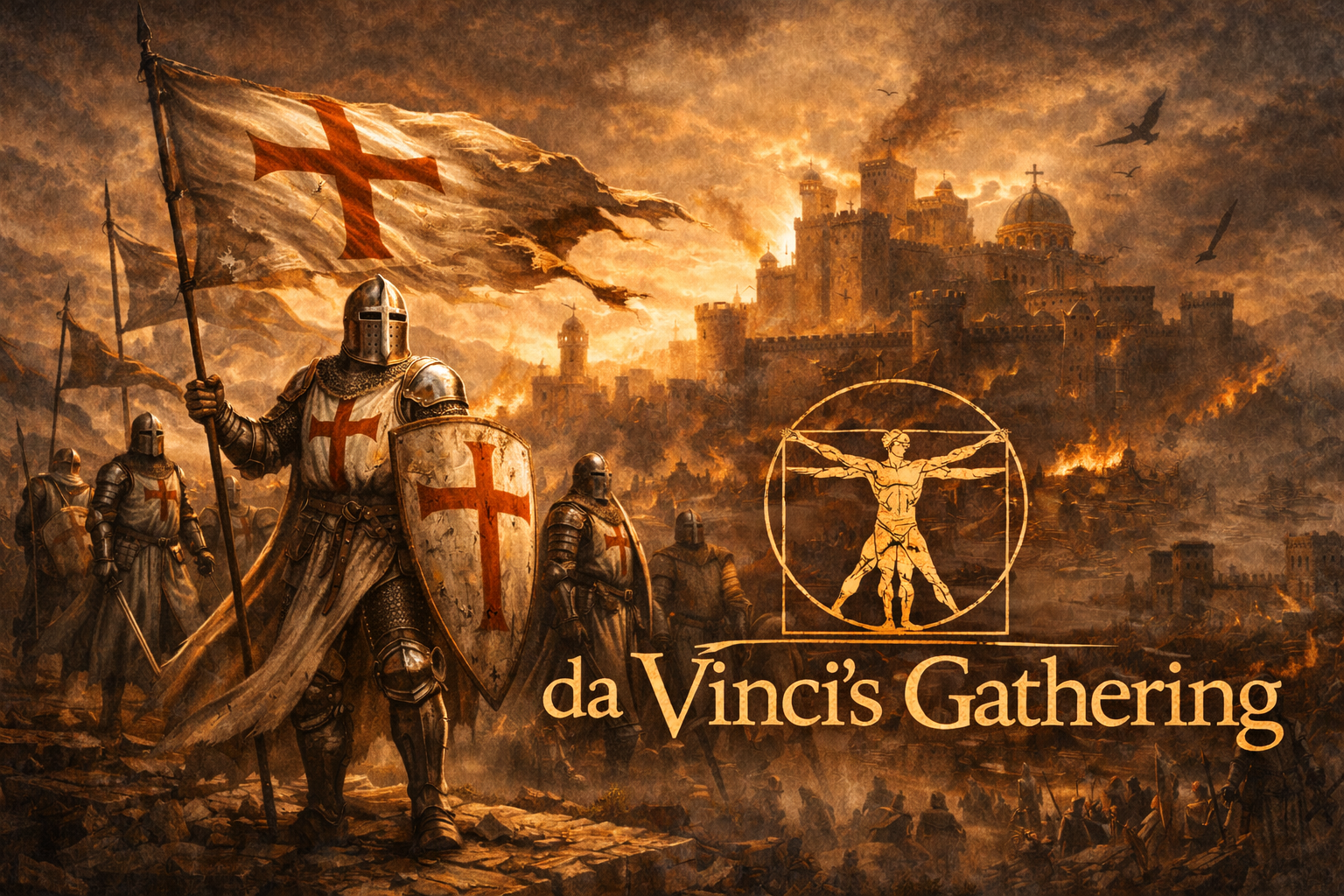
Every age has its orders.
Not the ones written into law or stamped with authority, but the quieter kind—formed by people who recognize a problem before it has a name, and decide to answer it before they are asked.
The Order of da Vinci’s Knights was born in such a moment.
This is an age of unprecedented power and unprecedented drift. Tools capable of reshaping culture sit in nearly every hand, yet most are used to distract, imitate, or idle. Knowledge is abundant, but wisdom is rare. Creativity is praised, but discipline is avoided. Everyone is encouraged to speak; few are expected to build.
The Order exists because that imbalance cannot be ignored forever.
da Vinci’s Knights are not nostalgic romantics or costume-wearing reenactors of a lost past. They are modern operators who understand an old truth: that progress without standards collapses inward, and freedom without responsibility rots into noise. Where others see chaos as permission to disengage, the Knights see obligation.
They step forward.
The Order takes its name not from a man, but from a model. Leonardo da Vinci was not revered because he was inspired. He was revered because he was relentless—crossing disciplines, mastering fundamentals, and refusing to accept the artificial boundaries of his time. Art, science, engineering, anatomy, warfare, architecture—none were separate domains to him. They were facets of the same pursuit: understanding reality well enough to shape it.
That pursuit defines the Knights.
A Knight of da Vinci’s Order is a builder first. They write, design, code, teach, experiment, and ship. They do not confuse commentary with contribution. They do not outsource judgment to crowds or algorithms. They cultivate taste, train skill, and hold themselves—and others—to standards that outlast trends.
But the Order is not individualistic.
Knights sponsor.
Knights mentor.
Knights enforce the code.
They recognize potential early and sharpen it deliberately. They understand that culture is not improved by consensus, but by example—repeated, visible, and uncompromising. Where standards slip, Knights restore them. Where talent drifts, Knights anchor it. Where noise dominates, Knights bring clarity.
This is not an order of conquest.
It is an order of construction.
The battlefield is cultural. The weapons are craft, discipline, and consistency. The banner is raised not to dominate, but to signal—to those watching quietly from the edges—that seriousness still has a home.
The Order grows slowly by design. Knights are not recruited through persuasion, but through recognition. Output precedes authority. Responsibility precedes belonging. The work comes first. Always.
We are still in the early days. This is the stage before banners are widely recognized, before the language spreads, before the influence becomes obvious. This is the stage where codes are written, standards are set, and the right people find each other without fanfare.
That is how every enduring order begins.
If you are reading this and feel something stir—not excitement, but resolve—then you already understand what this is. The Order does not ask for belief. It asks for participation. It does not promise safety. It promises meaning.
The Renaissance does not return on its own.
It is rebuilt—by those willing to take responsibility for it.
Welcome to the Order of da Vinci’s Knights.