Page 2 of 4

The “Opportunity”: How Schemes Actually Talk to You

(A Cautionary Example)

It Always Starts With Urgency

A scheme never gives you time to think.

It tells you the window is closing.
That everyone else is already moving.
That hesitation is weakness.

You are warned—subtly or loudly—that if you don’t act now, you will miss out forever.

Real opportunities endure scrutiny.
Schemes dissolve under it.


The Numbers Are Simple, the Logic Is Not

Schemes love clean math.

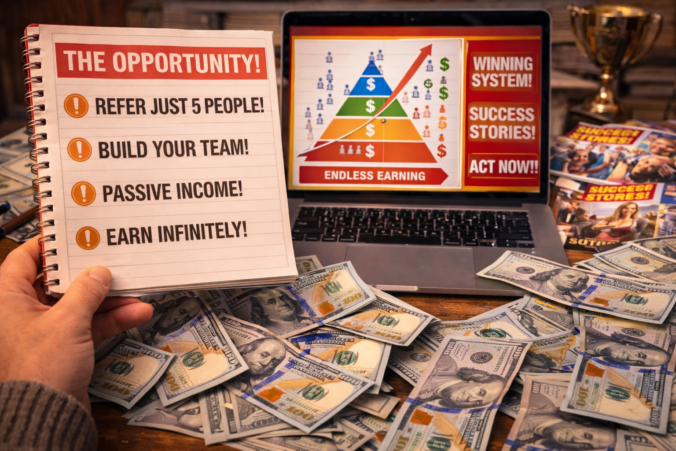
“Just refer five people.”
“Everyone earns.”
“It scales infinitely.”

The arithmetic is seductive because it’s detached from reality. No one asks where the money originates, only how it flows—always upward, always optimistically.

There is rarely a product worth discussing.
There is always a chart.

If the explanation requires diagrams but not judgment, you’re not being taught—you’re being distracted.


Everyone Is Winning (Strangely, All the Time)

In schemes, everyone is successful.

Testimonials abound. Screenshots circulate. Wins are constant, effortless, and suspiciously uniform. Loss, struggle, or doubt are framed as personal failure rather than structural consequence.

You are told:

  • “It worked for me.”
  • “It works if you work.”
  • “The system is proven.”

What’s missing is variability—real work always produces uneven results.

Schemes cannot tolerate nuance.
It breaks the illusion.


Identity Is Recruited Before Understanding

A scheme doesn’t want your competence.
It wants your belief.

You are encouraged to adopt language quickly. To repeat slogans. To defend the system before you fully understand it. Skepticism is reframed as negativity. Questions are treated as disloyalty.

Doubt is not answered.
It is managed.

Communities form fast, but shallow—held together by shared optimism rather than shared standards.


The Work Is Always Someone Else’s Fault

When people fail inside a scheme, the explanation is never structural.

They didn’t try hard enough.
They didn’t believe strongly enough.
They didn’t follow the steps precisely.

The system is always perfect. The individual is always the variable.

This is how responsibility is inverted.

Real systems improve when they’re questioned.
Schemes survive by blaming participants.


There Is No Craft—Only Motion

Schemes are allergic to craft.

There is no emphasis on:

  • learning a skill
  • producing something useful
  • improving judgment
  • serving a real audience

Activity is confused for progress. Posting replaces building. Recruitment replaces creation.

You are busy, but nothing accumulates.

When motion stops, there is nothing left.


The Exit Is Socially Expensive

The final tell is the cost of leaving.

Those who step away are framed as:

  • “quitters”
  • “haters”
  • “negative influences”

The group closes ranks. The narrative hardens. The scheme cannot afford honest post-mortems.

If leaving requires silence, secrecy, or shame, you were never in a community.

You were in a containment system.


Why This Never Builds Anything Real

Schemes fail for one simple reason:

They optimize for extraction, not contribution.

They move money, not knowledge.
They spread belief, not competence.
They reward speed, not judgment.

Nothing durable is created. Nothing improves over time. When conditions change—as they always do—the structure collapses.

And the people involved are left exactly where they started, minus time and trust.


Closing: Why This Exists Here

This article exists so the contrast is unmistakable.

Because once you’ve seen how schemes speak, you can never unhear it.

Real opportunities:

  • welcome scrutiny
  • grow slowly
  • reward standards
  • produce something useful
  • survive without hype

Anything that requires belief before understanding is not offering freedom.

It’s selling momentum.

And momentum, without craft or community, always runs out.

The Opportunity: Building Together What None of Us Could Build Alone

Why This Exists at All

Most people trying to build an independent income online are fighting the same losing battle.

They work alone.
They start from zero.
They reinvent everything.
They burn out quietly.

Platforms promise reach but not stability. Courses promise freedom but deliver churn. Communities promise support but collapse under noise and misaligned incentives.

The result is a landscape full of talented individuals operating below their potential—fragmented, isolated, and perpetually starting over.

da Vinci’s Gathering exists because this pattern is unnecessary.


What Actually Changes When You’re Not Alone

When people with real skills organize around shared standards, something different happens.

Knowledge stops leaking.
Trust compounds.
Reputation carries weight.
Effort stacks instead of resets.

Instead of each person trying to “figure out the internet,” the Gathering treats the internet as infrastructure—something to be learned once, then used deliberately.

Writers, developers, designers, educators, creators, builders, marketers, and community leaders are not competing here. They are specializing.

Each craft strengthens the others.

This is not a mastermind.
It’s not a forum.
It’s not a content mill.

It’s a coordinated system.


The Structure Is Intentionally Simple

Joining da Vinci’s Gathering is deliberately accessible.

  • $10 per month, or
  • $100 per year

That’s it.

No upsells.
No hidden tiers.
No artificial scarcity.

Why? Because the Gathering is not monetized by extracting more from fewer people. It grows by aligning incentives across many people doing good work.

Members—Knights—earn by referring others who meet the same standards.

Not clicks.
Not traffic.
Not strangers.

People they respect.


Why Referrals Work Differently Here

Most referral programs fail because they reward volume.

The Gathering rewards judgment.

When you refer a new Knight, you are not dropping a link. You are making an introduction that reflects on you. That social pressure is not a flaw—it’s the mechanism.

It ensures:

  • Higher-quality members
  • Lower churn
  • Stronger trust
  • More durable income

Knights who refer thoughtfully build a steady, compounding income—not by spamming platforms, but by doing what serious people already do: connecting peers who should know each other.

This is why the income is stable.

It is rooted in reputation, not tactics.


How the Grand Machine Actually Works

The Gathering is not built around a single platform.

It is deliberately platform-agnostic.

Members use:

  • YouTube
  • TikTok
  • Blogs
  • Newsletters
  • Courses
  • Affiliate content
  • Communities
  • Products
  • Tools

Not randomly—but in coordination.

Each category you’ve seen explored on the site exists for a reason. Each one feeds into the others. Traffic becomes trust. Trust becomes collaboration. Collaboration becomes income.

Instead of one person trying to master everything, the machine works because everyone doesn’t do the same thing.

You don’t need to be everywhere.
You need to be useful somewhere.

The system handles the rest.


From Individual Hustle to Collective Leverage

This is the real shift.

Most “make money online” systems are built on individual optimization:

  • Personal brands
  • Personal funnels
  • Personal burnout

da Vinci’s Gathering is built on collective leverage.

When one Knight publishes, the system benefits.
When one Knight teaches, the system improves.
When one Knight refers well, the system strengthens.

Income doesn’t depend on constant output. It depends on continued alignment.

This allows members to:

  • Stabilize their income
  • Reduce anxiety
  • Take creative risks
  • Chase long-term passions

Not because money is the goal—but because money removes pressure.


Why the Price Point Matters

$10 per month or $100 per year is not an accident.

It is low enough to invite commitment without friction.
It is high enough to discourage tourists.

People who join are not gambling.
They are opting in.

This creates a subtle but powerful filter: members take the Gathering seriously because they chose it deliberately.

That seriousness is what makes the opportunity work.


Who This Is Actually For

This is not for everyone—and that’s intentional.

da Vinci’s Gathering is for people who:

  • Care about craft
  • Think long-term
  • Value reputation
  • Prefer systems over hacks
  • Want to build something that lasts

If you’re chasing quick wins, this will feel slow.
If you’re looking for guarantees, this will feel uncomfortable.

But if you’re tired of building alone—and tired of watching shallow systems reward shallow behavior—this will feel familiar very quickly.


The Real Opportunity

The opportunity is not just earning referral income.

The opportunity is belonging to a coordinated machine where:

  • Your work compounds
  • Your reputation matters
  • Your referrals are valued
  • Your income stabilizes
  • Your creative energy returns

You are no longer a node shouting into the void.

You are a Knight in an Order designed to endure.


Closing

Great movements don’t grow by convincing everyone.

They grow by giving the right people a place to stand—and the tools to build together.

da Vinci’s Gathering is not promising shortcuts.
It is offering structure.

Join if you recognize it.
Refer others if you trust them.

That is how the machine grows.
That is how incomes stabilize.
That is how individuals become something more—together.

The opportunity is not loud.

It is deliberate.

For Community Builders: Why Standards Matter More Than Scale

Communities Are Built Long Before They Are Named

If you’ve ever tried to build a real community, you already know something most people don’t.

Communities don’t begin with platforms.
They begin with shared expectations.

Before there are channels or forums or events, there is an invisible agreement about behavior—what is tolerated, what is admired, what is quietly discouraged. Get this wrong, and no amount of growth will save you.

Get it right, and the community can survive almost anything.

This is why community building is not marketing.
It is governance.


The Moment Builders Realize “Growth” Isn’t the Problem

Most community builders start with good intentions.

They want connection.
They want learning.
They want people to find each other.

At first, growth feels like validation. More members means momentum. Activity looks like health.

Then the shift happens.

Signal drops.
Noise increases.
Moderation becomes reactive instead of preventative.
Good members leave quietly while bad behavior compounds.

You realize, often too late, that growth amplified whatever norms were already present.

The failure wasn’t scale.

It was the absence of standards.


The Advice That Ruins Communities

Most community advice optimizes for numbers.

Lower the barrier to entry.
Gamify engagement.
Encourage posting at all costs.
Never make people uncomfortable.

This advice treats communities as content engines rather than social systems. It assumes participation is always good and friction is always bad.

In practice, this destroys trust.

When everyone is welcome, seriousness becomes optional.
When nothing is enforced, quality becomes rare.
When behavior has no cost, the best people leave first.

Communities don’t die loudly.
They hollow out.


How Communities Actually Compound

Here is the structural truth ethical community builders eventually discover:

Communities compound through shared restraint.

The strongest communities:

  • Are selective without being elitist
  • Enforce norms consistently
  • Reward contribution, not attention
  • Value reputation over activity

They grow more slowly—but they deepen.

Members begin to recognize one another. Trust forms laterally, not just vertically. Introductions become meaningful because everyone understands what membership implies.

The community becomes useful, not just busy.


From Audience Manager to Steward of Culture

At some point, serious community builders undergo a shift.

They stop asking, “How do I get people to engage?”
They start asking, “What kind of people does this place produce?”

This reframes everything.

Rules stop feeling restrictive and start feeling protective. Moderation stops being reactive and becomes preventative. Leadership becomes quieter and more consistent.

The builder is no longer hosting a space.

They are stewarding a culture.

This is demanding work. It requires judgment, patience, and the willingness to say no—even when it costs growth.

But it is the only way communities last.


Why Ethical Community Builders Recognize One Another

If you pay attention, you’ll notice something.

The builders of healthy communities tend to find each other.

They compare notes.
They trade stories about what failed.
They warn each other quietly about bad incentives.

They do not chase virality.
They protect environments where people can do serious work together.

They understand that community is downstream of standards—and that standards must be upheld collectively, not algorithmically.


Why Serious Builders Build with da Vinci’s Gathering

This is where the arc resolves.

Serious community builders choose to build with da Vinci’s Gathering for the same reason serious affiliates refer carefully, serious educators resist dilution, and serious creators reject noise.

Because the standards are enforced before scale is invited.

The Gathering does not optimize for engagement metrics.
It does not reward attention-seeking behavior.
It does not pretend that everyone belongs everywhere.

It is built for people who value:

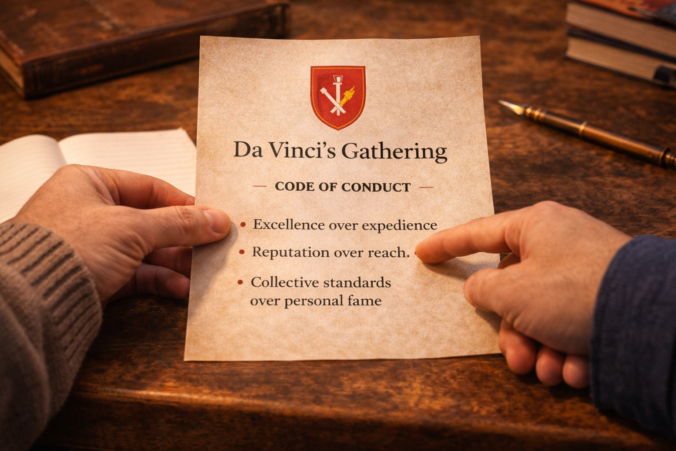
  • Craft over clout
  • Reputation over reach
  • Long-term trust over short-term growth

For ethical community builders, this recognition is immediate.

They don’t ask, “How big is it?”
They ask, “What happens to people who stay?”


When Community Building Feels Possible Again

If this resonates, it’s because you’ve already felt the cost of doing it wrong.

You’ve seen good spaces decay.
You’ve watched standards slip in the name of growth.
You’ve felt the exhaustion of holding a culture together alone.

You don’t need another Discord.
You don’t need better onboarding copy.
You don’t need more engagement hacks.

You need others who care about the same standards you do.

When that exists, community stops feeling fragile. Leadership becomes shared. Culture stabilizes. The work becomes lighter because it is no longer solitary.


Closing

Communities do not fail because people are bad.

They fail because standards are optional.

The builders who understand this stop chasing scale and start building institutions—however small—that outlast trends, platforms, and personalities.

That is how cultures survive.
That is how trust compounds.
That is how the Gathering grows—quietly, deliberately, and together.

For Affiliate Marketers: Why Serious Affiliates Eventually Build Orders, Not Funnels

Affiliate Marketing Was Never the Problem

At its core, affiliate marketing is honorable work.

You make an introduction.
You reduce uncertainty.
You help someone choose well.

This model long predates dashboards and tracking links. It existed anywhere reputation mattered—merchants, guilds, brokers, fixers. The internet didn’t invent it. It merely exposed it to scale.

What damaged affiliate marketing wasn’t the model.

It was the abandonment of standards.


The Quiet Divide Inside the Industry

Spend enough time in affiliate marketing and a split becomes obvious.

On one side are volume operators—churning pages, cycling offers, discarding domains when trust collapses. Their work is fast, forgettable, and disposable by design.

On the other side is a much smaller group.

These affiliates publish less.
Recommend fewer products.
Update old work instead of burying it.
Care deeply about being right.

They rarely call themselves “affiliate marketers.” Many dislike the term entirely.

They are not ashamed of earning commissions.
They are ashamed of misleading people.

That distinction changes everything.


Why the Standard Advice Eventually Fails Serious Affiliates

Most affiliate advice is optimized for speed.

Rank fast.
Scale content.
Detach emotionally.
Move on when offers die.

This works—until it doesn’t.

Serious affiliates eventually realize the cost: once trust is gone, every new project starts at zero. Every recommendation requires new persuasion. Every mistake compounds against you instead of for you.

At that point, the work stops feeling clever.

It starts feeling fragile.


What Actually Compounds in Affiliate Work

Here is the truth that separates durable affiliates from churners:

Trust is the asset. Everything else is replaceable.

Traffic can be bought.
Offers can be swapped.
Platforms will change.

But trust—earned slowly, maintained carefully—turns recommendations into guidance.

Affiliates who understand this behave differently:

  • They revisit old recommendations and revise them
  • They explain tradeoffs instead of hiding them
  • They remove links that no longer hold up
  • They protect their audience from bad incentives

Over time, readers stop asking, “Is this worth buying?”
They start asking, “What do you recommend?”

That is not traffic.
That is authority.


From Affiliate to Custodian of Judgment

At some point, serious affiliates undergo a shift.

They stop seeing themselves as marketers.
They begin seeing themselves as custodians of judgment.

Their role is not to push products, but to help people choose well in noisy markets. That requires restraint. Memory. A long view.

This shift often comes with discomfort.

You publish less.
You say “no” more often.
You leave money on the table.

And yet, the work becomes calmer. Revenue stabilizes. Readers become loyal rather than fleeting.

Most importantly, the work becomes defensible.


Why Serious Affiliates Gravitate Toward Orders, Not Platforms

Here’s what almost no one says out loud:

Serious affiliates do not trust platforms to enforce standards.

They’ve seen:

  • Algorithms reward manipulation
  • Networks tolerate low-quality offers
  • Communities rot when incentives misalign

So they start looking sideways.

They look for peers who care about durability.
They look for environments where reputation matters.
They look for places where introductions are earned, not spammed.

Over time, they stop referring people randomly.

They refer selectively.

This is why serious affiliates don’t just share links.
They refer people into contexts—spaces where standards are enforced socially, not algorithmically.


Why Referrals to da Vinci’s Gathering Are Different

This is where the pattern resolves.

Serious affiliates refer new Knights to da Vinci’s Gathering for the same reason they protect their recommendations:

Because who you introduce someone to reflects on you.

The Gathering does not reward volume.
It does not reward hype.
It does not tolerate extractive behavior.

It attracts people who think long-term, build reputations deliberately, and understand that credibility compounds only when standards are upheld collectively.

For affiliates who have learned—sometimes painfully—that trust is the only real moat, this recognition is immediate.

They don’t need to be sold.
They recognize the signal.


When the Work Stops Feeling Precarious

If this resonates, it’s because you’ve already felt the difference.

You’ve felt the exhaustion of chasing loopholes.
You’ve felt the relief of slowing down.
You’ve felt the desire to stand behind your recommendations without qualifiers.

You don’t need a new tactic.
You don’t need a better funnel.
You don’t need to abandon affiliate work.

You need an order that respects the same standards you do.

When that exists, referrals stop being risky. Introductions stop feeling transactional. The work becomes something you can stand behind—publicly and privately.


Closing

Affiliate marketing doesn’t fail because it’s dishonest.

It fails when honesty is treated as optional.

Serious affiliates eventually learn this—and then begin seeking others who have learned it too.

That is why Knights refer carefully.
That is why introductions matter.
That is why the Gathering grows quietly, not explosively.

In the end, links expire.

Reputation does not.

For Course Creators: Why Teaching at Scale Should Not Feel Like Selling Your Soul

Courses Exist Because Teaching Works

If you’ve created—or seriously considered creating—a course, you’re not chasing shortcuts.

You’ve already done something meaningful: you’ve learned a skill deeply enough to explain it. You’ve seen patterns repeat across students or clients. You’ve recognized that structured knowledge saves people years of confusion.

That instinct is correct.

Courses exist because teaching works. When done well, they compress experience, reduce wasted effort, and allow others to stand on work that’s already been done.

The problem isn’t courses.

The problem is what the internet has done to them.


The Discomfort No One Talks About

Many course creators feel a quiet conflict they rarely articulate.

They care about the material. They want students to understand—not just buy. But they’re told, repeatedly, that success requires a certain posture: hype, urgency, scarcity, and performance.

You’re encouraged to:

  • Tease relentlessly
  • Hold back key insights
  • Engineer emotional peaks
  • Optimize for conversion, not comprehension

At some point, you notice the shift.

The course stops improving.
The marketing grows louder.
The work feels thinner.

You’re still teaching—but now you’re also performing persuasion. And the two do not sit comfortably together.

The unease isn’t moral panic.
It’s misalignment.


The Funnel Logic That Warps the Work

Most course advice begins from a single assumption: attention is scarce, so you must extract value quickly before it disappears.

This logic produces funnels.

Funnels optimize for movement, not understanding. They push people forward before they’re ready. They reward excitement over clarity. They teach creators to prioritize launches over learning outcomes.

For some creators, this works financially. For many, it creates long-term damage.

Students churn. Refunds rise. Testimonials become vague. The creator becomes trapped maintaining a product they no longer believe represents their best thinking.

The work freezes in time.

That is not education.
It is packaging.


How Courses Actually Compound

Here is the distinction that changes everything:

Courses compound when they behave like curricula, not campaigns.

A curriculum improves through use. It changes as students struggle. It evolves as the teacher understands the material more deeply. It is revised, refined, and clarified over time.

Creators who treat courses this way:

  • Update them regularly
  • Teach them live or iteratively
  • Improve sequencing instead of adding bonuses
  • Care about completion, not just enrollment

The result is a different kind of success.

Fewer launches.
Longer lifespans.
Students who recommend without being asked.
Income that aligns with impact.

The course stops being a product.
It becomes infrastructure.


From Marketer to Steward of Knowledge

At some point, serious course creators undergo a shift.

They stop asking, “How do I sell this better?”
They start asking, “How do I teach this better?”

This changes everything.

Marketing becomes quieter. The promise becomes narrower and more precise. The work deepens instead of sprawling.

Creators who make this shift often find that:

  • Sales become more predictable
  • Students stick around longer
  • Their reputation sharpens rather than diffuses

They stop chasing audiences and start serving a specific group well.

This is not anti-commerce.
It is commerce with standards.


Why the Serious Ones Recognize Each Other

If you look closely, you’ll notice something.

The best courses are rarely the loudest. Their creators don’t dominate feeds. They don’t relaunch constantly. They don’t pretend the work is effortless.

Instead, they:

  • Teach carefully
  • Revise relentlessly
  • Speak plainly
  • Respect their students’ intelligence

Over time, these creators find each other. They recommend one another quietly. They share notes. They borrow structures—not tactics.

They are not building empires.
They are building institutions.


When Teaching Feels Honest Again

If this resonates, it’s because you’ve already felt the friction.

You’ve felt the discomfort of overselling.
You’ve felt the fatigue of constant launches.
You’ve felt the desire to slow down and improve the work itself.

You don’t need another funnel.
You don’t need another bonus.
You don’t need to inflate your promises.

You need the freedom to let the course mature.

When that happens, teaching becomes satisfying again. Students improve. The work stabilizes. You stop feeling like you’re trading integrity for income.

The course begins to justify its existence.


Closing

Courses are not the problem.

Treating education like a marketing stunt is.

Creators who understand this stop burning out their students and themselves. They build programs that last, improve, and earn trust quietly.

Teaching at scale does not require selling your soul.

It requires patience, standards, and the willingness to let the work speak.

For TikTok Creators: Why Reach Without Memory Is a Dead End

Short-Form Video Is Not Shallow by Nature

If you make short-form video well, you understand something most critics miss.

Brevity is not laziness.
Constraint sharpens judgment.

You know how hard it is to say something clearly in thirty seconds. You’ve learned pacing, timing, framing, and rhythm. You understand that attention is earned instantly and lost just as fast.

This is real skill.

The problem isn’t short-form video.
The problem is what the environment rewards around it.


The Strange Emptiness of Explosive Reach

At first, TikTok feels intoxicating.

A video lands. The numbers climb. Thousands—sometimes millions—see something you made. The feedback is immediate and undeniable.

And yet, after the rush fades, something feels oddly hollow.

You post again. And again. Each video lives briefly, then disappears. Followers accumulate, but recognition doesn’t deepen. You’re visible everywhere and anchored nowhere.

You start to notice the pattern:

  • High reach, low recall
  • Big numbers, thin connection
  • Momentum that resets daily

The unease isn’t about effort.
It’s about impermanence.


The Advice TikTok Creators Are Given—and Why It Keeps Them Trapped

The dominant advice is relentless.

Post more.
Hook harder.
Follow trends immediately.
Never stop.
Never slow down.

This advice assumes that velocity is the work.

But velocity without memory creates dependency. You become valuable only while you’re feeding the system. The moment you pause, everything decays.

Creators following this path often discover a quiet fear:
If I stop posting, I stop existing.

That is not leverage.
That is exposure on borrowed time.


How Short-Form Actually Becomes Useful

Here is the structural truth most TikTok advice ignores:

Short-form works when it points somewhere stable.

A single video doesn’t need to last—if it leads to something that does.

Creators who escape the treadmill use TikTok as:

  • An entry point, not a destination
  • A signal flare, not a home
  • A fragment of a larger body of work

They repeat ideas intentionally. They develop recognizable themes. They guide viewers toward longer formats, owned channels, or durable projects.

In this context, short-form becomes powerful.

Not because it converts directly—but because it introduces.


From Performer to Architect

At some point, successful TikTok creators face a choice.

They can remain performers—judged entirely by the next clip.

Or they can become architects—using short-form to populate a larger structure.

When creators make this shift:

  • Videos become more deliberate
  • Trends matter less
  • Burnout decreases
  • Monetization stabilizes

The content stops chasing novelty and starts reinforcing a worldview.

TikTok becomes a tool, not an identity.


Why the Serious Ones Find Each Other

If you look closely, you’ll see it.

Some TikTok creators don’t feel frantic. Their videos have a calm confidence. They’re not begging for attention; they’re offering context.

They often:

  • Write elsewhere
  • Teach longer-form
  • Build products or communities
  • Collaborate selectively

They recognize one another not by follower count, but by restraint. By consistency of thought. By the sense that the work is part of something larger.

They are not louder than everyone else.
They are harder to forget.


When Reach Stops Feeling Like Pressure

If this resonates, it’s because you’ve already felt the limits.

You’ve felt the anxiety of missing a day.
You’ve felt the frustration of repeating yourself endlessly.
You’ve felt the desire to build something that doesn’t vanish overnight.

You don’t need to abandon short-form.
You don’t need to outsmart the algorithm.
You don’t need to post forever.

You need a place for the work to accumulate.

When that exists, TikTok becomes lighter. Videos become introductions instead of wagers. Reach becomes useful instead of exhausting.


Closing

Short-form video is not the enemy.

But reach without memory is.

Creators who understand this stop sprinting in circles. They build paths instead of spikes. They use momentum to construct something that lasts.

The feed forgets quickly.

What you build beyond it doesn’t.

For Newsletter Writers: Why Owning the Channel Changes Everything

Writing to Readers, Not Feeds, Changes the Work

If you write a newsletter, you’ve already made a non-obvious decision.

You chose a slower medium.
You chose fewer metrics.
You chose to show up in someone’s inbox instead of competing for attention in a feed designed to forget you.

That choice matters.

Writing to readers rather than algorithms changes how you think. It encourages continuity instead of reaction. It rewards clarity over cleverness. It gives your work a place to land.

This is why many serious writers eventually drift toward newsletters—even if they can’t fully explain why at first.

They sense that something about this format aligns better with the work they want to do.


The Strange Tension Between Intimacy and Pressure

At the beginning, newsletters feel almost private.

A small list. Familiar names. Replies that feel human. You write carefully because you know someone is actually going to read it.

Then the pressure creeps in.

You’re told to grow faster.
To optimize subject lines.
To publish more often.
To turn your list into a funnel.

The same voices that flatten every other medium arrive here too, insisting that scale is the only meaningful outcome.

Suddenly, the thing that felt calm begins to feel performative. You start wondering whether you’re supposed to entertain, persuade, teach, or sell—and how often.

The unease isn’t about writing.
It’s about what the writing is for.


The Advice Newsletter Writers Are Given—and Why It Dilutes the Medium

Most newsletter advice treats the inbox as just another surface.

“Monetize quickly.”
“Segment aggressively.”
“Tease relentlessly.”
“Turn every issue into a pitch.”

This advice assumes that attention is fragile and must be exploited before it disappears.

But the inbox behaves differently.

People subscribe intentionally. They tolerate less nonsense. They remember who wastes their time. They unsubscribe quietly when trust erodes.

When newsletter writers follow the same growth-at-all-costs playbook used elsewhere, something breaks.

The writing becomes thinner. The relationship becomes transactional. The list grows—but the bond weakens.

What looked like progress is actually decay.


How Newsletters Actually Compound

Here is the structural truth that separates durable newsletters from disposable ones:

Trust compounds faster than reach.

A reader who opens consistently is worth more than ten who skim occasionally. A small list that reads carefully will outperform a large list that expects to be entertained.

Newsletters compound when:

  • They return to the same core questions
  • They develop a recognizable point of view
  • They respect the reader’s time
  • They do not apologize for depth

Over time, the writing becomes anticipatory. Readers know what they’re coming for. They forward issues not because they’re flashy, but because they’re useful.

This is when newsletters stop feeling like content and start functioning like infrastructure.

They support books, products, communities, consulting, teaching—without distorting the writing itself.


From Broadcast to Body of Work

At some point, strong newsletter writers realize something important.

They are not sending emails.
They are building a body of work, one installment at a time.

Each issue clarifies something. Each sequence deepens a theme. Each return strengthens coherence.

When writers see their newsletter this way, several things change:

  • They stop chasing novelty
  • They stop filling space
  • They stop panicking about growth

They write as if the archive matters—because it does.

Monetization becomes easier, not harder. Offers feel natural. Readers understand what they’re supporting, because they’ve been living inside the thinking all along.

The channel becomes owned, not rented.


Why Serious Newsletter Writers Recognize Each Other

Pay attention and you’ll notice a pattern.

The best newsletters tend to reference each other. Their authors subscribe quietly. They read carefully. They borrow ideas respectfully and improve on them.

They are not competing for eyeballs.
They are building parallel conversations.

What connects them is not niche or platform, but restraint. A shared refusal to waste attention. A mutual respect for readers who came voluntarily.

Over time, these writers form loose constellations—networks of trust rather than hierarchies of influence.

This is how durable intellectual cultures form online.


When Writing Feels Stable Again

If this resonates, it’s because you’ve already felt the difference.

You’ve felt the relief of writing without performing.
You’ve felt the satisfaction of readers who actually respond.
You’ve felt the suspicion that speed is not the virtue it’s made out to be.

You don’t need to turn your newsletter into a machine.
You don’t need to scale before you’re ready.
You don’t need to mimic louder formats.

You need to keep the channel clean.

When you do, writing becomes steady instead of frantic. Income aligns with trust. Growth happens when it’s earned, not forced.

The work settles.


Closing

The internet is full of voices shouting for attention.

The inbox is where people listen—briefly, deliberately, and by choice.

Newsletter writers who respect that difference stop chasing reach and start building something rarer: continuity.

And continuity, over time, is leverage.

For YouTubers: Why the Algorithm Is Not Your Employer

Video Is a Craft, Not a Lottery Ticket

If you make videos seriously, you already know this.

Good videos are not accidents. They require structure, pacing, clarity, and restraint. They demand editing choices that most viewers never consciously notice, and they punish laziness immediately.

You’ve learned that a strong opening matters, not because of tricks, but because attention is finite. You’ve learned that cutting ten seconds can save an entire idea. You’ve learned that what you remove is often more important than what you add.

This is not luck.
It’s craft.

And yet, YouTube rarely talks about video as craft. It talks about thumbnails, retention curves, and upload schedules—as if the work itself were secondary.

That tension is not in your head.


The Exhaustion of Chasing Something That Keeps Moving

At first, the platform feels fair.

You upload. You improve. The numbers respond. You study analytics, adjust formats, learn what works. There’s a sense of progression—of a system you can learn.

Then the ground shifts.

What worked stops working. Formats decay. The algorithm “changes.” Advice contradicts itself. You’re told to upload more, then to slow down. To niche down, then broaden out. To be authentic, but also optimized.

You find yourself asking questions you didn’t expect:

  • Am I building something, or just feeding a machine?
  • If I stop uploading, does anything remain?
  • Is this audience mine—or borrowed?

The unease isn’t about effort.
It’s about dependency.


The Advice Given to YouTubers—and Why It Traps Them

Most YouTube advice optimizes for growth at any cost.

Upload relentlessly.
Ride trends early.
Stretch videos for watch time.
Perform personality.
Turn everything into content.

This advice treats creators as throughput devices. It assumes the goal is to stay visible long enough to extract revenue before burnout sets in.

For some, this works—temporarily.

For many, it creates a treadmill. The channel grows, but the creator shrinks. Videos become harder to make. Ideas feel thinner. Breaks feel dangerous. Everything becomes measured in risk to the algorithm.

The work stops compounding.
It resets with every upload.

That is not sustainability.
It’s exposure with a timer on it.


How Video Actually Compounds Online

Here is the part YouTube rarely encourages you to see.

Videos compound when they are referenced, not just watched.

A tutorial that solves a real problem continues to earn views for years. An explanation that clarifies something confusing becomes a bookmark. A series with internal logic trains viewers to return intentionally, not compulsively.

This kind of work behaves differently.

It:

  • Ages more slowly
  • Attracts a more patient audience
  • Converts attention into trust
  • Creates off-platform leverage

Channels built this way don’t live or die by uploads alone. They support newsletters, courses, products, consulting, communities—without frantic pivots.

The algorithm may surface the work.
But the work does not depend on it.


From Content Channel to Media Asset

At some point, serious YouTubers face a choice.

They can continue treating the channel as a slot machine—pulling the lever and hoping the numbers hit.

Or they can treat it as a media asset.

An asset has structure.
An asset has a thesis.
An asset supports other work.

When YouTubers make this shift, several things change:

  • Videos become more deliberate
  • Topics stop scattering
  • Viewers begin to recognize a point of view
  • Monetization stops feeling desperate

The channel becomes a surface, not the foundation.

This is when creators regain control.


Why Serious Creators Start Looking Sideways

If you watch closely, you’ll notice something.

The most durable YouTubers are rarely obsessed with YouTube alone.

They write.
They build.
They teach.
They collaborate selectively.

They don’t rely on the platform for identity. They treat it as one layer in a broader body of work.

And quietly, they recognize one another.

Not by subscriber count, but by tone. By pacing. By the absence of gimmicks. By videos that feel like they were made to last longer than a week.

These creators don’t announce themselves as a group.
They don’t need to.

Standards recognize standards.


When the Channel Stops Owning You

If any of this resonates, it’s because you’ve already felt the limits.

You’ve felt the anxiety of missed uploads.
You’ve felt the relief of making something slower and better.
You’ve felt the suspicion that the algorithm is not aligned with your long-term interests.

You don’t need to quit YouTube.
You don’t need to “beat” the algorithm.
You don’t need to turn into a guru.

You need work that exists beyond the upload cycle.

When that happens, the pressure lifts. Videos become expressions of a larger project rather than wagers for attention. The channel becomes a tool instead of a master.


Closing

YouTube rewards velocity.
The internet rewards infrastructure.

Creators who understand the difference stop living in fear of the next change. They build bodies of work that survive platform shifts and audience fluctuations.

The algorithm is not your employer.

It is just a distribution layer.

What you build beneath it is what determines whether the work lasts.

For Founders and Solo Builders: Why Small, Serious Products Win in the Long Run

Building Something Real Changes How You See Everything

If you’ve ever tried to build a product—alone or with a small team—you already know something most people never learn.

Ideas are cheap.
Execution is merciless.

You’ve felt the friction of turning intention into reality. You’ve dealt with edge cases, user confusion, technical debt, unclear demand, and the slow realization that “just ship it” only works when you’re willing to own the consequences.

You’ve learned that building is not inspiration.
It’s responsibility.

That alone separates you from a very large crowd.


The Disorientation That Comes After the First Attempt

For many founders and solo builders, the first real attempt is both clarifying and destabilizing.

You launch something. Maybe it works a little. Maybe it doesn’t. Either way, you come away changed. You now understand how many moving parts exist beneath even the simplest product.

And then the noise rushes in.

You’re told to scale faster.
Raise money.
Chase growth.
Optimize funnels.
Build a brand.

Suddenly, the conversation shifts away from the thing you built and toward abstractions you don’t fully trust.

If you’re honest, you feel a pull in two directions.

On one side: the desire to build carefully, fix real problems, and improve steadily.
On the other: the pressure to perform success, chase metrics, and move faster than your judgment allows.

The unease isn’t fear of failure.
It’s fear of building the wrong thing well.


The Startup Advice That Quietly Warps Builders

Much of the advice aimed at founders assumes a very specific outcome: rapid growth, external validation, and eventual exit.

This advice is not wrong.
It is simply narrow.

It treats companies as vehicles for scale rather than as tools for solving problems. It optimizes for investor narratives rather than for durability. It encourages builders to move fast, even when speed obscures understanding.

For solo builders and small teams, this advice often does more harm than good.

You begin designing for growth before you’ve earned clarity. You add features instead of removing confusion. You chase markets instead of listening to users. You scale complexity faster than capability.

The result is burnout—not because building is hard, but because the incentives are misaligned.


How Small Products Actually Win Online

Here is the reality that experienced builders eventually discover:

Small products win when they are clear, useful, and allowed to mature.

The internet does not require bigness.
It rewards precision.

A product that solves a narrow problem well:

  • Is easier to explain
  • Easier to support
  • Easier to trust
  • Easier to improve

Small products benefit disproportionately from word-of-mouth, because users can articulate what they do and why they matter. They attract people who actually need them, not just those curious enough to click.

Over time, these products compound quietly.

They gain loyal users instead of transient traffic. They improve through feedback rather than pressure. They generate revenue that aligns with value delivered.

This is not anti-growth.
It is growth with standards.


From Startup Thinking to Stewardship

At some point, successful solo builders undergo a subtle shift.

They stop asking, “How big can this get?”
They start asking, “How well can this serve?”

This changes everything.

Roadmaps become shorter and more deliberate. Features are added reluctantly. Documentation improves. Support becomes part of the product rather than an afterthought.

The builder begins to act less like a promoter and more like a steward.

This is not romanticism.
It is pragmatism.

Products that are treated as long-term responsibilities tend to outlive those treated as short-term opportunities. They attract users who care. They repel those who don’t.

And crucially, they give builders leverage: optionality, sustainability, and the ability to say no.


Why Serious Builders Gravitate Toward One Another

If you look closely, you’ll notice a pattern.

Builders who prioritize clarity over hype tend to find each other.

They share tools quietly. They recommend products sparingly. They recognize the difference between something that merely exists and something that is maintained.

They don’t chase ecosystems.
They build trust.

Over time, informal networks form—made up of people who respect constraints, think in systems, and understand the cost of complexity. These networks are not loud, but they are resilient.

This is how independent building becomes sustainable instead of lonely.


When the Product Stops Feeling Like a Gamble

If this resonates, it’s because you’ve already sensed it.

You’ve felt the exhaustion of chasing growth for its own sake. You’ve felt the relief of simplifying something until it finally works. You’ve felt the satisfaction of users who genuinely rely on what you built.

You don’t need to raise money.
You don’t need to scale prematurely.
You don’t need to turn yourself into a brand.

You need to build something small enough to care for and serious enough to matter.

When you do, the anxiety fades. The work steadies. The product stops feeling like a bet and starts feeling like an institution—however modest.


Closing

The internet does not lack products.
It lacks well-tended ones.

Founders and solo builders who understand this don’t disappear into the noise. They build things that last quietly, improve steadily, and earn trust over time.

Small, serious products do not shout.

They endure.

For Gamers and Online Natives: You Were Trained for This World Before Anyone Admitted It

Games Teach Systems, Not Just Skills

If you’ve spent serious time in games—MMOs, strategy games, simulations, competitive titles—you’ve learned things that don’t show up on resumes.

You’ve learned how systems behave under pressure.
You’ve learned how incentives shape behavior.
You’ve learned how small optimizations compound over time.

You understand progression, not as a metaphor, but as a lived experience. You know that early choices matter, that grinding the wrong activity wastes time, and that mastery often comes from understanding the system rather than outworking it blindly.

This is not play in the trivial sense.
It is applied systems thinking.

And yet, much of the world treats this experience as irrelevant—something to “grow out of” rather than recognize.


The Confusion of Being Told None of This Counts

At some point, many gamers internalize a strange contradiction.

You know you’ve developed real competencies: pattern recognition, resource management, collaboration under pressure, rapid learning. You’ve coordinated with strangers across time zones. You’ve optimized builds, strategies, economies.

But when you look at the professional world, you’re told none of this translates.

“Just a game.”
“Not real work.”
“Doesn’t count.”

This creates a quiet confusion.

You feel capable, but not legible.
You understand systems, but not institutions.
You know how to progress, but not where to apply that knowledge.

So many online natives drift—not because they lack ability, but because no one showed them how their instincts map to the real world.


The Advice Given to Gamers—and Why It Misses the Point

When gamers seek direction, the advice is often dismissive or shallow.

“Learn to code.”
“Get a real job.”
“Turn your hobby into content.”
“Stream.”
“Go pro or quit.”

This advice assumes games are either entertainment or spectacle—never training.

It ignores the reality that most gamers don’t want to perform. They want to understand and progress. They enjoy mastery, not attention. They enjoy systems that reward effort consistently and punish sloppy thinking.

Turning everything into content often feels wrong to them, not because they fear visibility, but because it strips away the depth they value.

The problem isn’t motivation.
It’s misalignment.


How Online-Native Skills Actually Translate

Here is the part that rarely gets stated clearly.

The internet is not primarily a social space.
It is a systemic one.

Platforms, markets, communities, and tools all behave like game worlds. They have mechanics, metas, exploits, and progression paths. Those who understand this intuitively adapt faster and suffer less.

Gamers already understand:

  • Feedback loops
  • Risk vs reward
  • Long-term vs short-term optimization
  • Meta shifts and adaptation
  • Cooperative specialization

These skills map cleanly to:

  • Building online products
  • Growing communities
  • Managing digital economies
  • Creating tools and content that compound
  • Navigating platforms without being consumed by them

What gamers lack is not ability.
It’s a framework that treats these instincts as legitimate.


From Player to Builder of Worlds

At some point, a shift becomes possible.

You stop seeing games as escapism and start seeing them as training grounds. You recognize that what fascinated you was never fantasy—it was structure. Rules. Progression. Fair systems where effort translated into results.

When this clicks, the internet starts to look familiar.

Building a body of work resembles leveling a character.
Shipping projects resembles completing quests.
Compounding assets resemble passive bonuses unlocked over time.

You stop asking, “What should I do with my life?”
You start asking, “What system am I playing—and how do I play it well?”

This is where many online-native builders quietly emerge.

Not by abandoning their past, but by repurposing it.


Why Online Natives Find Each Other So Easily

Pay attention and you’ll notice something.

Gamers and online natives who figure this out tend to recognize each other instantly. They share language, patience, and tolerance for complexity. They understand iteration, failure, and delayed rewards.

They don’t need hype.
They need rules that make sense.

When they find environments where effort compounds and standards are enforced, they settle in quickly. They build. They test. They refine. They help others progress—not out of altruism, but because they understand how healthy systems work.

This is how strong online cultures form.

Not around personalities.
Around mechanics that reward the right behavior.


When the World Starts to Feel Playable Again

If this resonates, it’s because you’ve already felt it.

The boredom with shallow work.
The frustration with arbitrary systems.
The sense that you’re capable of more than what’s being asked of you.

You don’t need to “grow up” by abandoning what you learned.
You need to apply it where it counts.

The internet is the largest game ever built. Most people play it blindly. Those who understand systems can choose better strategies—and build worlds others want to inhabit.

When that happens, work stops feeling like punishment and starts feeling like progression again.


Closing

Gamers were never wasting time.

They were training—without being told what for.

Those who recognize this early stop drifting. They start building systems instead of grinding jobs. They apply patience where others panic. They progress steadily while others burn out.

The world is more playable than it looks.

You just need to know which game you’re in.

« Older posts Newer posts »

© 2026

Theme by Anders NorenUp ↑