Month: January 2026 (Page 3 of 4)

For Freelancers: Why the Hourly Model Quietly Caps Your Future

Freelancing Is Real Work—Even When It’s Treated Like a Stopgap

If you freelance, you already operate closer to reality than most people.

You don’t hide behind titles or org charts. You ship. You deliver. You solve problems for money. When the work is good, you get paid. When it’s not, you don’t. The feedback loop is immediate and unforgiving.

That alone puts you ahead of the curve.

You’ve learned how to scope work, manage clients, communicate constraints, and take responsibility for outcomes. You’ve learned—often the hard way—that clarity is worth more than enthusiasm, and that vague promises create expensive problems.

This is not a beginner’s position.
It is a practitioner’s one.

And yet, despite doing real work, many freelancers feel strangely stuck.


The Feeling That You’re Always Starting Over

At first, freelancing feels like freedom.

You escape the office. You choose your clients. You set your rates. You enjoy the direct relationship between effort and income. For a while, this feels like control.

Then the pattern emerges.

Each project begins at zero.
Each client must be convinced anew.
Each month resets the scoreboard.

You can be busy and still feel precarious. You can raise your rates and still feel capped. Time becomes the bottleneck. No matter how skilled you become, your income remains tethered to availability.

You start noticing the tradeoffs.

Turning down bad clients feels risky.
Taking time to think feels expensive.
Building anything long-term feels indulgent.

The unease isn’t about effort.
It’s about fragility.


The Advice Freelancers Are Given—and Why It Only Goes So Far

When freelancers talk about this tension, the advice is familiar.

Raise your rates.
Niche down.
Productize your services.
Build packages.
Automate onboarding.

Some of this advice helps. None of it solves the underlying issue.

The hourly model—even when dressed up—still treats your work as ephemeral. You deliver value, get paid, and move on. Nothing remains except testimonials and invoices.

Even “productized services” often change the packaging, not the structure. You’re still selling your time, just in cleaner units. The work doesn’t compound. It disappears as soon as it’s delivered.

This creates a ceiling that skill alone cannot break.


How Work Actually Compounds Online

Here is the distinction that changes everything:

Services disappear. Assets remain.

A freelancer who only delivers work for clients is building experience, but not leverage. A freelancer who also creates assets—writing, tools, frameworks, systems—is building something that persists.

Examples:

  • A consultant who publishes clear explanations of recurring client problems
  • A designer who documents systems instead of just deliverables
  • A developer who turns internal tools into public ones
  • A strategist who writes case studies that teach rather than sell

These things do not replace client work immediately. They sit alongside it.

Over time, they do something subtle but powerful:
they pre-sell trust.

Clients arrive already convinced.
Rates become easier to defend.
Work becomes more selective.

Eventually, some opportunities stop looking like “freelance” at all.


From Service Provider to Builder of Infrastructure

The identity shift is uncomfortable at first.

You realize that your most valuable work isn’t what you deliver privately—it’s what you externalize. The thinking behind the work. The patterns you see repeatedly. The decisions you make instinctively.

When you begin sharing those deliberately, something changes.

You stop pitching.
You stop chasing.
You stop explaining yourself from scratch.

Your work begins to travel without you.

This doesn’t require becoming a guru. It requires making your judgment legible.

Freelancers who do this well often discover they are no longer competing in the same market. They are not interchangeable. They are not evaluated on price alone. They are chosen for how they think.

This is leverage earned, not claimed.


Why Independent Builders Recognize One Another

If you pay attention, you’ll notice a quiet divide.

Some freelancers stay trapped in cycles of busyness. Others gradually exit the hourly frame entirely—into retainers, partnerships, teaching, tools, or ownership.

The difference is not talent.

It’s whether their work leaves a trail.

Those who externalize their thinking find each other. They read one another’s work. They collaborate selectively. They refer work not as favors, but as signals of trust.

They don’t form agencies.
They form networks.

These networks are small, high-signal, and resilient. They are built on shared standards, not shared branding.

This is how independence becomes durable instead of fragile.


When the Work Stops Resetting to Zero

If this resonates, it’s because you’ve already felt the limits.

You’ve felt the exhaustion of endless delivery.
You’ve felt the anxiety of feast-or-famine cycles.
You’ve felt the desire to build something that doesn’t vanish when the project ends.

You don’t need to abandon freelancing.
You don’t need to scale into management.
You don’t need to pretend you’re a startup.

You need work that persists.

When that exists, everything else changes. Time opens up. Rates stabilize. Choices widen. You begin to feel less like a vendor and more like a builder again.

The work stops feeling temporary.


Closing

Freelancing is not a dead end.
But the hourly model is not a destination.

Those who understand this don’t rush. They build quietly, alongside their client work, until the balance shifts.

Not through hustle.
Through accumulation.

The internet rewards those who leave something behind.

For Educators and Coaches: Teaching Without Becoming a Content Mill

Teaching Is Older Than the Internet—and Still Misunderstood

If you teach for a living—or feel called to—you already understand something fundamental.

Teaching is not the transfer of information.
It is the shaping of understanding.

A good teacher doesn’t overwhelm. They sequence. They sense when to push and when to wait. They recognize that learning happens not when information is delivered, but when it is integrated.

This applies whether you teach math, fitness, writing, business, art, or life itself.

And yet, much of what passes for “education” online ignores this entirely.

The internet has made teaching visible, scalable, and monetizable—but it has also distorted what teaching is supposed to feel like. If you’ve been doing this long enough, you’ve likely felt that distortion personally.


The Quiet Unease Beneath the Work

At first, teaching online feels liberating.

You can reach more people. You can help at scale. You can finally earn without institutional permission. Students find you directly, often because something you explained landed when nothing else did.

But over time, something starts to feel off.

You’re encouraged to post constantly. To simplify endlessly. To package insight into bite-sized, algorithm-friendly fragments. To repeat the same surface-level ideas because they “perform.”

You notice that depth is punished. Nuance confuses the feed. Real learning takes time, but the platforms reward immediacy.

You begin to feel a pressure—not to teach better, but to teach faster.

The unease isn’t about money.
It’s about dilution.

You didn’t get into this to become a content factory. You wanted to help people understand. To guide transformation, not generate clicks.

And yet, the environment seems designed to pull you in the opposite direction.


The Advice Given to Teachers—and Why It Breaks Them

When educators and coaches voice this discomfort, they’re usually given the same prescription.

Scale your content.
Build funnels.
Automate everything.
Repurpose endlessly.
Turn your knowledge into a “product stack.”

Some of this advice is functional. Much of it is corrosive.

It treats teaching as extraction—how much value can be pulled from your knowledge with the least ongoing effort. It assumes that your role is to front-load insight, package it cleanly, and then disappear behind automation.

But teaching doesn’t work that way.

The more you automate prematurely, the more brittle the work becomes. The more you chase scale, the more you flatten the very distinctions that made your teaching effective.

Many educators feel this tension viscerally. They start to resent their own material. They recycle lessons they’ve outgrown. They feel trapped by systems they built too early.

The problem isn’t teaching online.
It’s teaching without structure or standards.


How Teaching Actually Compounds Online

Here is the part that changes everything.

Teaching compounds when it is iterative, not when it is maximally distributed.

A clear explanation given once is helpful.
A refined explanation given repeatedly becomes foundational.

Educators who thrive online do something different from the norm. They return to the same core ideas over and over, improving how they explain them, noticing where students get stuck, and adjusting accordingly.

Their work forms a curriculum, even if they never label it that way.

This creates compounding effects:

  • Students who actually finish
  • Trust that deepens over time
  • Material that improves instead of stagnates
  • Income that aligns with impact

Instead of one-off courses, they build bodies of work. Instead of funnels, they build relationships. Instead of scaling prematurely, they let understanding accumulate.

The internet is remarkably good at preserving good teaching—when that teaching is designed to last.


From Information Seller to Builder of Understanding

At some point, the identity shift becomes unavoidable.

You are not an “info product creator.”
You are a steward of understanding.

Your value is not the facts you know, but how you sequence them. How you contextualize them. How you help people see what they couldn’t see before.

When educators adopt this frame, several things change.

They stop racing the algorithm.
They stop apologizing for depth.
They stop mistaking scale for success.

They begin designing their work so that:

  • Each piece builds on the last
  • Students progress rather than churn
  • Teaching improves with use

Money follows naturally—not because it’s extracted, but because it supports a system that works.

Teaching stops feeling like performance and starts feeling like practice again.


Why Serious Educators Recognize Each Other

If you look closely, you’ll notice something.

The educators who care most about their students tend to find each other.

They recommend one another quietly. They reference each other’s work with care. They share a language of responsibility—about what they owe their students, and what they refuse to compromise.

They don’t chase audiences.
They cultivate seriousness.

What connects them is not niche or branding, but standards. A shared belief that teaching is a craft, not a trick.

Over time, these connections form informal networks—spaces where educators sharpen each other rather than compete. Where quality is enforced not by metrics, but by mutual respect.

This is how real educational cultures persist, even in chaotic environments.


When Teaching Becomes Sustainable Again

If any of this resonates, it’s because you’ve already felt the pull.

The pull away from endless posting.
The pull toward fewer, better explanations.
The pull toward work that improves with time instead of exhausting you.

You don’t need to abandon the internet.
You don’t need to reject money.
You don’t need to scale at all costs.

You need an environment where learning is allowed to take time.

When that environment exists, teaching becomes sustainable again. You stop repeating yourself mindlessly. You stop feeling like you’re trading depth for survival. You begin building something that supports both you and your students.

The work steadies.


Closing

The internet does not lack teachers.
It lacks good ones who are allowed to stay good.

Educators and coaches who understand this don’t disappear. They become anchors. Their work becomes reference points. Their students become capable, not dependent.

Teaching, done properly, does not burn out.

It endures.

For Designers and Artists: Why Taste Is the Rarest—and Most Valuable—Skill Online

Taste Is a Form of Intelligence

If you are a designer or an artist, you already know something that is difficult to explain and impossible to fake.

You know when something works.

You can feel proportion before you can justify it. You recognize balance without measuring it. You see what’s wrong long before you can articulate why. Over time, your eye sharpens—not because you learned rules, but because you absorbed patterns.

This is not decoration.
It is judgment.

Taste is the ability to distinguish signal from noise, quality from imitation, intention from accident. It’s what allows you to look at two nearly identical things and know—immediately—which one will last.

Most people do not develop this faculty.
Those who do often underestimate its value.


The Frustration of Working in a World That Doesn’t See What You See

At some point, many designers and artists experience a quiet disorientation.

You improve. Your work becomes cleaner, more restrained, more intentional. You solve problems more elegantly. You remove rather than add. And yet, the world seems to reward the opposite.

Louder designs win attention. Brighter colors outperform subtlety. Trends eclipse fundamentals. You’re asked to “make it pop” when you know the problem is conceptual, not aesthetic.

You watch mediocre work succeed because it flatters the algorithm. You watch thoughtful work get ignored because it refuses to shout. Over time, this creates a specific kind of fatigue.

Not creative burnout—but a loss of faith in the environment.

You’re not confused about your craft.
You’re confused about how it’s supposed to survive out here.


The Advice Artists Are Given—and Why It Backfires

When artists and designers express this tension, the advice is familiar.

Post more.
Chase trends.
Optimize for platforms.
Turn yourself into a brand.
Make what performs, not what endures.

This advice treats taste as a liability.

It assumes that if your work doesn’t immediately attract attention, the solution is more output, more exaggeration, more compromise. It frames visibility as the goal and craft as an optional luxury.

For some, this works in the short term.
For many, it corrodes the very thing that made their work distinctive.

You start designing for reaction instead of resonance. You simplify past the point of meaning. You chase styles you don’t respect and slowly lose confidence in your own eye.

The result isn’t success.
It’s alienation from your own work.


How Taste Actually Compounds on the Internet

Here is what rarely gets said plainly:

Taste compounds slowly—but powerfully—when it is attached to something useful.

A designer who consistently improves systems, interfaces, or experiences teaches people what good looks like. An artist who returns to the same themes with increasing restraint builds a recognizable sensibility. Over time, their work becomes a reference point.

This is not about virality.

It’s about trust in judgment.

People return to designers and artists not because they are loud, but because they make better decisions. Their work reduces friction. It feels considered. It solves problems without announcing itself.

On the internet, this kind of work persists.

A thoughtful design case study continues to teach long after publication. A visual system that solves a real problem gets reused, adapted, cited. A body of work with internal consistency becomes a signal to collaborators, clients, and peers.

Taste, when paired with clarity, becomes leverage.


From Maker of Objects to Keeper of Standards

At some point, a shift occurs.

You realize that your value is not the artifacts you produce, but the decisions embedded within them.

You are not just making images, layouts, or visuals.
You are enforcing standards—sometimes invisibly.

Standards about:

  • What is necessary and what is excess
  • What serves the user and what flatters the creator
  • What will age well and what will not

When you see yourself this way, the work changes.

You stop chasing novelty.
You stop apologizing for restraint.
You stop explaining yourself to people who don’t share your values.

You begin to build systems instead of one-offs. You document your thinking. You show your process—not to perform expertise, but to make judgment legible.

This attracts a different class of opportunity.

People who care about quality recognize quality. They don’t need to be convinced. They need to know you exist.


Why Those With Taste Tend to Find Each Other

Look closely and you’ll notice something.

Designers and artists with real standards tend to orbit one another.

They share references quietly. They recognize each other’s work without fanfare. They collaborate sparingly and deliberately. They are allergic to excess and unimpressed by spectacle.

They don’t form scenes.
They form networks.

What binds them is not a style or a movement, but a shared intolerance for sloppiness. A mutual respect for work that holds up under scrutiny.

These connections are rarely announced. They accumulate over time through consistent signals—tone, restraint, coherence.

This is how serious creative cultures persist, even when trends churn constantly around them.


When the Work Begins to Attract the Right Kind of Attention

If any of this resonates, it’s because you’ve already felt it.

You’ve felt the pull toward less, not more. Toward refinement instead of expansion. Toward work that solves real problems rather than winning short-term approval.

You don’t need to become louder.
You don’t need to simplify your thinking.
You don’t need to abandon your taste.

You need an environment that recognizes judgment as value.

When that environment exists, things change quietly. The right collaborators appear. Projects become more interesting. Work begins to stack instead of scatter.

Your taste stops feeling like a liability and starts functioning like an asset.


Closing

The internet does not lack creativity.
It lacks standards.

Designers and artists who understand this do not disappear. They become harder to replace.

They build slowly.
They choose carefully.
They let their work speak without apology.

Taste, properly applied, does not shout.

It endures.

For Developers: Why the Best Coders Are Building in Public Now

Software Is a Craft Long Before It Is a Career

If you are a developer, you already think differently from most people.

You break problems into components. You reason about systems instead of surfaces. You understand that elegant solutions are usually quieter than flashy ones, and that most failures come from ignoring constraints rather than lacking ambition.

You also know that good software is not produced by speed alone. It emerges from iteration, testing, and the willingness to delete what doesn’t hold up. You’ve learned—often painfully—that clever code ages poorly, and that clarity is a form of kindness to whoever comes after you.

This is not how software is usually talked about online.

Online, coding is framed as a ladder: languages to master, frameworks to chase, jobs to land. But if you’ve been doing this long enough, you know that the real skill is not syntax. It’s judgment.

That already places you in a smaller group than you might realize.


The Feeling That the Game Isn’t Quite What It Claims to Be

At some point, most serious developers notice a disconnect.

You improve. You learn more. You solve harder problems. And yet, the rewards feel oddly decoupled from the quality of your thinking. Visibility seems to matter more than depth. Titles matter more than understanding. Loud opinions travel farther than quiet competence.

You watch mediocre tools succeed because they’re marketed well. You watch excellent libraries go unnoticed because their creators didn’t want to play the visibility game. You watch hiring processes optimize for keywords rather than capability.

If you’re honest, this produces a particular kind of fatigue—not burnout, exactly, but disillusionment. A sense that the system rewards the wrong signals, and that your actual strengths are under-leveraged.

This isn’t cynicism.
It’s pattern recognition.


The Career Advice That Doesn’t Quite Work Anymore

When developers express this frustration, the advice is predictable.

Grind LeetCode.
Switch stacks.
Job-hop aggressively.
Build a personal brand.
Post hot takes on social media.

Some of this advice is useful in narrow contexts. Most of it assumes a world where employment is the primary unit of value, and where your worth is best expressed through credentials and titles.

That world is fading.

Not because jobs are disappearing, but because leverage has shifted.

The problem with most career advice for developers is that it treats software as labor rather than as infrastructure. It assumes your work only matters when someone hires you to do it, rather than when it exists independently in the world.

This keeps developers dependent on intermediaries—companies, recruiters, platforms—that do not share their incentives.


How Software Actually Compounds on the Internet

Here is the reality most developers discover too late:

Code that exists in public compounds differently than code that lives only inside companies.

A well-written library teaches every person who reads it.
A clear technical article becomes a reference.
An open project establishes reputation without self-promotion.
A documented tool builds trust before it ever asks for anything.

None of this requires virality.

It requires legibility.

The internet is unusually good at preserving useful artifacts. A GitHub repository, a technical essay, a small open-source tool—these things continue to work for you long after they’re written. They demonstrate how you think, not just what you know.

Over time, this creates optionality.

Developers who build in public are easier to evaluate, easier to trust, and harder to ignore. They are not competing on resumes. They are competing on evidence.

And evidence ages better than claims.


From Employee to System Builder

At some point, the identity shift becomes unavoidable.

You are not “just a coder.”
You are a builder of systems.

Systems that:

  • Reduce friction
  • Encode judgment
  • Scale understanding
  • Persist beyond any single job

When you see your work this way, the question changes.

It’s no longer “How do I get hired?”
It becomes “What am I building that continues to matter?”

This does not mean abandoning employment. Many developers continue to work inside companies while building externally. The difference is that their external work gives them leverage.

They can leave when standards drop.
They can choose projects deliberately.
They can teach, consult, or build independently without starting from zero.

This is not rebellion.
It’s resilience.


Why Serious Builders Gravitate Toward One Another

If you look closely, you’ll notice a pattern.

Developers who build real things tend to find each other. They follow the same repositories. They read the same long-form posts. They recognize competence by its absence of noise.

They don’t need to announce themselves.
Their work speaks clearly enough.

Over time, informal networks form—not around hype, but around reliability. Around people who ship, maintain, document, and improve things that others depend on.

This is how durable technical cultures form.

Not through branding.
Through standards.


When the Work Begins to Carry Its Own Weight

If any of this resonates, it’s because you’ve already seen it in practice.

You’ve seen how one solid project can open more doors than a dozen applications. You’ve seen how teaching clearly can matter more than claiming expertise. You’ve seen how tools that solve boring problems end up being the most valuable ones.

You don’t need to become louder.
You don’t need to optimize for attention.
You don’t need to pretend to be something you’re not.

You need your work to exist in a context that rewards seriousness.

When that context is right, things change quietly but decisively. Opportunities arrive without chasing. Work becomes cumulative instead of exhausting. You stop feeling like you’re starting over every few years.

The code starts to speak for itself.


Closing

This is how developers stop being interchangeable and start becoming inevitable.

Not by gaming systems.
Not by inflating profiles.
But by building things that hold up under use.

The internet is full of noise.
It is starving for infrastructure.

Those who understand the difference don’t stay invisible for long.

For Writers: Why Deliberate Writing Outlasts Everything Else

Writing Is a Serious Craft (Even When the Internet Pretends Otherwise)

If you are a writer, you already possess a skill that most people underestimate and misuse.

You know that writing is not simply expression. It is compression. It takes tangled thought and renders it legible. It takes intuition and gives it edges. It forces clarity where vagueness would otherwise survive.

You also know—whether you learned it formally or the hard way—that good writing is work. It requires rereading your own sentences and feeling where they fail. It demands patience, restraint, and a tolerance for uncertainty. It often means sitting with an idea longer than feels comfortable, resisting the urge to publish something merely because it is finished.

This already places you in a minority.

Most people who “write” online are not practicing a craft. They are filling space. They are reacting, summarizing, reposting, performing insight rather than earning it. You can feel the difference immediately. So can other serious readers.

If you’ve stayed with writing long enough to care about quality, coherence, and precision, then you’re not here by accident. You are already operating under a standard, even if you haven’t named it.

That matters, because everything that follows depends on it.


The Uneasy Feeling That Something Isn’t Adding Up

And yet, even with that standard, something likely feels unresolved.

You write carefully. You revise. You try to say something true. Sometimes you publish consistently, sometimes you pull back to think longer. Either way, the results feel unpredictable. Work you labored over disappears quietly. Pieces you wrote quickly sometimes travel farther than they deserve to.

You watch other writers gain traction by saying less, not more—by simplifying, flattening, exaggerating, or repeating the same safe ideas in slightly different packaging. You don’t resent them exactly, but you notice the mismatch.

Effort does not map cleanly to outcome.

Over time, this creates a low, persistent tension. Not despair, but doubt. A sense that you’re doing real work in an environment that doesn’t quite know what to do with it. That the internet rewards something, but you’re not convinced it’s the thing you want to optimize for.

This tension is easy to dismiss. You tell yourself it’s just part of the game, that everyone feels this way, that you should simply publish more, care less, or lower your expectations.

But that instinct—to blunt your own standards in order to survive—is the warning signal.

You’re not frustrated because you’re failing.
You’re frustrated because you’re misaligned.


The Advice Writers Are Given—and Why It Fails Them

When writers voice this discomfort, they are almost always given the same advice.

Publish more often.
Shorten your pieces.
Chase platforms.
Build a “personal brand.”
Stay visible at all costs.

This advice is not malicious. It is incomplete.

It treats writing as content production and assumes that attention is the primary bottleneck. It suggests that if you simply increase output and exposure, meaning and income will eventually follow.

For some people, this works—briefly. Usually for those willing to adapt their voice to whatever performs best. For those comfortable becoming interchangeable.

But for writers who care about craft, this advice produces predictable side effects: burnout, dilution, and a creeping sense of dishonesty. You find yourself writing things you don’t quite believe, or writing faster than your thinking can support. You begin optimizing for reaction rather than understanding.

The problem isn’t volume itself.
It’s volume without coherence.

A writer who publishes constantly without returning to the same core questions is not building a body of work. They are leaving fragments scattered across platforms, each one disconnected from the last.

This creates visibility, but not leverage. Motion, but not momentum.

And over time, it erodes the very thing that made the work worth doing.


How Writing Actually Compounds Online

Here is the part that is rarely explained clearly.

The internet does not reward frequency.
It rewards accumulated clarity.

Clarity compounds when a writer returns to the same territory repeatedly, refining their position, correcting themselves, deepening their understanding. Readers begin to recognize not just individual pieces, but a mind at work. A pattern. A perspective that can be relied on.

This is why a single essay that articulates something cleanly can continue to circulate for years, while dozens of reactive posts vanish within days. The former becomes a reference point. The latter becomes debris.

Think of the writers you return to voluntarily. Not because they post often, but because when they do, you trust that it will be worth your attention. That trust is not created by branding. It is created by consistency of thought over time.

From a structural perspective, this trust becomes an asset.

It leads to:

  • Readers who subscribe rather than skim
  • Essays that are shared long after publication
  • Opportunities that arrive without pitching
  • Income that feels like a continuation of the work, not a betrayal of it

None of this requires virality. In fact, virality often works against it.

The internet is vast, but human attention is not. Writers who build slowly, deliberately, and coherently are easier to find—and harder to replace—than those who chase novelty.


From Content Producer to Builder of Thought

At this point, the problem becomes clearer.

You are not struggling because you are a bad writer.
You are struggling because you are operating as if you are a content creator.

That identity is too small for the work you are actually doing.

A serious writer is not producing posts. They are building an intellectual structure—a set of ideas that reinforce each other, evolve over time, and eventually stand on their own.

Seen this way, your writing has a different purpose.

Each piece is not a performance.
It is a load-bearing element.

Some pieces clarify first principles.
Some explore implications.
Some test boundaries.
Some correct earlier mistakes.

Together, they form something coherent enough that others can step inside it.

When writers adopt this frame, several things change immediately:

  • They stop apologizing for depth
  • They stop chasing every platform
  • They stop measuring success by short-term reaction

They begin asking better questions:

  • What am I actually trying to understand?
  • What problem am I returning to?
  • What does my body of work make possible that a single post cannot?

This shift is subtle, but decisive.

Money, when it arrives, arrives as reinforcement—not compensation. A newsletter grows because people trust the thinking. A book sells because the ideas already exist. Consulting, teaching, or collaboration opportunities emerge because others recognize the structure you’ve built.

This is not luck.
It is alignment between craft and environment.


Why Serious Writers Eventually Find One Another

Here is the part most writers do not see until they encounter it indirectly.

You are not alone in this instinct.

Across the internet, there are small, quiet clusters of writers who have arrived at similar conclusions. They publish less than they could. They avoid unnecessary spectacle. They take their time. They recognize each other not through follower counts, but through tone, restraint, and intellectual honesty.

They are not competing for attention.
They are building parallel structures.

What connects them is not style, ideology, or platform—but standards. An unspoken agreement about what counts as real work and what does not. About when to publish and when to wait. About the difference between sharing insight and performing it.

These writers tend to find one another eventually. Through citations. Through long-form exchanges. Through mutual respect expressed quietly rather than publicly.

This is not accidental.

When standards exist, organization follows—even if no one announces it.


When the Work Starts to Stand on Its Own

If you’ve felt the tension between craft and visibility, between depth and scale, between seriousness and spectacle, then nothing here should feel foreign.

You don’t need to reinvent yourself.
You don’t need to publish faster.
You don’t need to become louder.

You need an environment that does not punish care.

That realization does not require urgency. It does not demand immediate action. It simply changes how you interpret what you’re already experiencing.

From there, the next steps reveal themselves.

Deliberate writing is slower at the beginning.
It is quieter.
It often looks like stagnation from the outside.

But over time, it becomes unmistakable.

The work starts to hold its own weight.


Closing

This is the standard going forward.

Not persuasion.
Not instruction.
Recognition.

For writers, and soon for others, this is how the Gathering grows: not by recruiting, but by making itself legible to those already leaning in the right direction.

The Internet Changed Work. Most People Missed What That Meant.

The internet did not eliminate work.

It changed who gets paid and why.

For most of modern history, earning a living required permission. You needed a credential, a job title, a company, a boss, or an institution willing to validate you. Even highly skilled people were constrained by geography and gatekeepers.

That constraint is gone.

A writer can publish without a publisher.
A designer can sell without an agency.
A teacher can reach students without a classroom.
A developer can ship without a company.

This is not theory. It is observable reality.

And yet, most people behave as if nothing has changed.

What “Working on the Internet” Actually Looks Like

Working on the internet is not posting constantly.
It is not chasing trends.
It is not building an audience before you have anything to offer.

Real internet work looks boring up close.

It looks like:

  • Writing one clear essay per week for a year
  • Publishing tutorials that solve a specific problem
  • Sharing what you’re learning while building something real
  • Improving one idea in public until it becomes useful

Consider a simple example.

A person who understands a narrow topic—say, personal finance for freelancers—writes one solid article per week explaining real problems they’ve personally solved. At first, no one notices. After six months, a handful of readers return. After a year, those articles rank in search, get shared, and quietly establish trust.

That person now has options:

  • A newsletter people actually read
  • A guide they can sell without hype
  • Consulting requests they didn’t chase

Nothing viral happened.
Nothing clever happened.

Work happened.

Why Most Attempts Fail

Most people try to monetize before they’re useful.

They create a course before they’ve taught anyone.
They sell a product before they’ve solved a problem repeatedly.
They chase “reach” instead of trust.

This is backwards.

The internet does not reward announcements.
It rewards evidence.

Evidence looks like:

  • A body of work
  • Consistency over time
  • Improvement that’s visible

When those exist, monetization becomes obvious instead of forced.

Leverage Is Built, Not Claimed

A single YouTube video is not leverage.
A TikTok post is not leverage.
A tweet is not leverage.

Leverage is an asset that continues working when you’re not present.

Examples:

  • A library of articles that answer common questions
  • A video series that teaches a repeatable skill
  • A tool people use without thinking about who made it

A developer who builds a small, ugly tool that solves one annoying problem often earns more than someone chasing viral attention with no follow-through.

A writer with 500 dedicated readers who trust them will outperform someone with 50,000 followers who don’t.

This is the part people miss.

Money Follows Usefulness, Not Aesthetics

The internet does not care how polished you look.
It cares whether someone’s life is better because you showed up.

Money arrives when:

  • Your work saves time
  • Reduces confusion
  • Eliminates friction
  • Teaches something clearly

It does not arrive because you declared yourself an expert.

A person who documents how they fixed their own problems—clearly, honestly, and repeatedly—often out-earns people performing expertise they haven’t earned yet.

Why This Matters

Creators who cannot earn from their work eventually compromise it.

They take sponsorships they don’t believe in.
They chase trends they don’t respect.
They dilute standards to survive.

Learning how to earn from your work is not selling out.

It is defensive infrastructure.

It allows you to:

  • Keep working without permission
  • Say no to things that erode quality
  • Invest time in work that compounds slowly

The goal is not wealth as spectacle.
It is independence as stability.

The Quiet Advantage

The internet favors people who can do three things at once:

  1. Learn continuously
  2. Build consistently
  3. Wait patiently

Most won’t.

They’ll quit when the numbers are small.
They’ll pivot when validation doesn’t arrive.
They’ll mistake silence for failure.

Builders recognize silence as the default.

They keep working anyway.

That is why, months or years later, they appear to “come out of nowhere.”

They didn’t.

They were working while no one was watching.

The Old Code: Why Rules Create Freedom

Every generation repeats the same mistake.

It mistakes freedom for the absence of rules.

And every time, the result is the same: drift, decay, and noise disguised as expression.

The Old Code exists because this mistake is ancient—and predictable.

True freedom has never come from removing constraints. It comes from choosing the right ones.

Civilizations, crafts, and orders do not rise when everything is permitted. They rise when standards are enforced, boundaries are clear, and expectations are understood by all who enter. The Renaissance did not flourish because artists were unrestrained. It flourished because they were trained—under masters, within traditions, against demanding criteria that separated work from indulgence.

Rules were not the enemy of creativity.
They were its scaffolding.

The modern world rejects this instinct. It celebrates openness without obligation, expression without responsibility, and participation without contribution. The result is a culture that feels free but behaves aimlessly—capable of everything, committed to nothing.

This is not liberation.
It is entropy.

The Old Code understands a harder truth: constraints sharpen intent.

A writer who accepts no rules never finishes.
A builder without standards ships nothing that lasts.
A community without enforcement collapses into performance.

Rules do not limit the serious. They filter them.

They create friction—just enough to reveal who is committed and who is merely curious. They turn interest into practice and curiosity into craft. They make excellence legible.

This is why orders exist.

The Order of da Vinci’s Knights is bound by rules not to control its members, but to free them from drift. Standards remove ambiguity. Expectations remove excuses. Discipline removes distraction.

A Knight does not wonder what is required.
They know.

The Old Code is simple, but it is not easy:

  • You build before you speak.
  • You ship before you seek validation.
  • You accept critique without negotiation.
  • You mentor those who earn it.
  • You enforce standards without apology.

These rules do not constrain freedom. They create it—by eliminating indecision, lowering cognitive noise, and aligning effort toward meaningful output.

Within the Code, creators move faster, not slower. They waste less energy debating what counts and more energy producing work that does. They are not paralyzed by infinite possibility, because the path forward is clear.

This is the paradox modern culture resists:
the stricter the standard, the wider the freedom on the other side.

When everyone is allowed to do anything, nothing matters.
When only serious work is permitted, everything does.

The Old Code does not promise comfort. It promises clarity.

It asks for restraint in exchange for momentum.
Discipline in exchange for depth.
Responsibility in exchange for meaning.

That is the trade every enduring order makes.

The New Renaissance will not be built by those demanding fewer rules. It will be built by those willing to live under better ones.

The Code has returned—not to dominate, but to organize.

And within it, the builders are finally free to work.

Creators and Spectators

The Line That Divides Everything

Every culture eventually splits in two.

Not by class.
Not by wealth.
Not even by intelligence.

It splits into creators and spectators.

This divide is older than technology, older than institutions, older than the internet—but the modern age has made it impossible to ignore. Never before have so many people had the ability to create, and never before have so many chosen not to.

That choice is the point.

Spectators are not evil. They are not stupid. They are not lazy in the obvious sense. Most are busy, informed, opinionated, and endlessly aware of what others are doing. They read. They watch. They react. They discuss.

But they do not build.

Creators, by contrast, operate under a different internal law. They experience the same distractions, the same doubts, the same access to entertainment and escape—but something interrupts the cycle. An idea nags. A standard pulls. A sense of obligation forms.

Creators feel uncomfortable leaving things unmade.

This is not a personality trait.
It is a posture.

Spectators ask, “What’s happening?”
Creators ask, “What’s missing?”

Spectators measure reality through commentary.
Creators measure it through output.

Spectators wait for permission—social, institutional, or emotional.
Creators assume responsibility and accept the consequences.

The internet promised to turn everyone into a creator. What it actually did was give spectators better seats and louder voices. Likes replaced standards. Visibility replaced craft. Reaction replaced contribution. And slowly, subtly, participation was redefined downward.

Posting became “creating.”
Opinions became “work.”
Consumption became “research.”

The result is a culture rich in awareness and poor in substance.

This is where Orders form.

Historically, when the gap between spectators and creators grows too wide, disciplined minorities emerge to restore balance. Guilds. Academies. Orders. Circles bound not by belief, but by practice.

The Order of da Vinci’s Knights exists precisely at this fault line.

Knights are creators by definition. Not because they are more inspired, but because they are more accountable. They understand that ideas unused decay, that talent untrained rots, and that culture left unattended collapses into noise.

A Knight does not ask whether their work will be noticed.
They ask whether it meets the standard.

They do not confuse audience with authority.
They do not confuse momentum with meaning.

They build first.
They refine second.
They speak last.

This is why the divide matters.

Spectator cultures drift. Creator cultures compound.

Spectators chase relevance.
Creators build infrastructure.

Spectators inherit the future.
Creators design it.

The Gathering does not exist to shame spectators. It exists to offer a crossing. A line in the sand that says: here is where watching ends and responsibility begins.

No one is born on one side permanently. Everyone drifts at times. The difference is who returns to the work.

If this piece unsettles you, that’s a good sign. It means you recognize the tension. The Order does not require perfection—only commitment. Output precedes identity. Work precedes belonging.

This is the choice every serious person must eventually make.

You can observe the Renaissance.
Or you can help build it.

The Knights have already chosen.

From the New Order to da Vinci’s Gathering

Origins, Lineage, and the Continuation of the Code

Movements do not appear fully formed.

They are inherited.

Long before da Vinci’s Gathering had a name, before Knights and banners and manifestos, there was a smaller experiment conducted in a harsher environment—one that tolerated no ambiguity and rewarded no passivity. Its setting was virtual, but its lessons were real.

It was called the New Order.

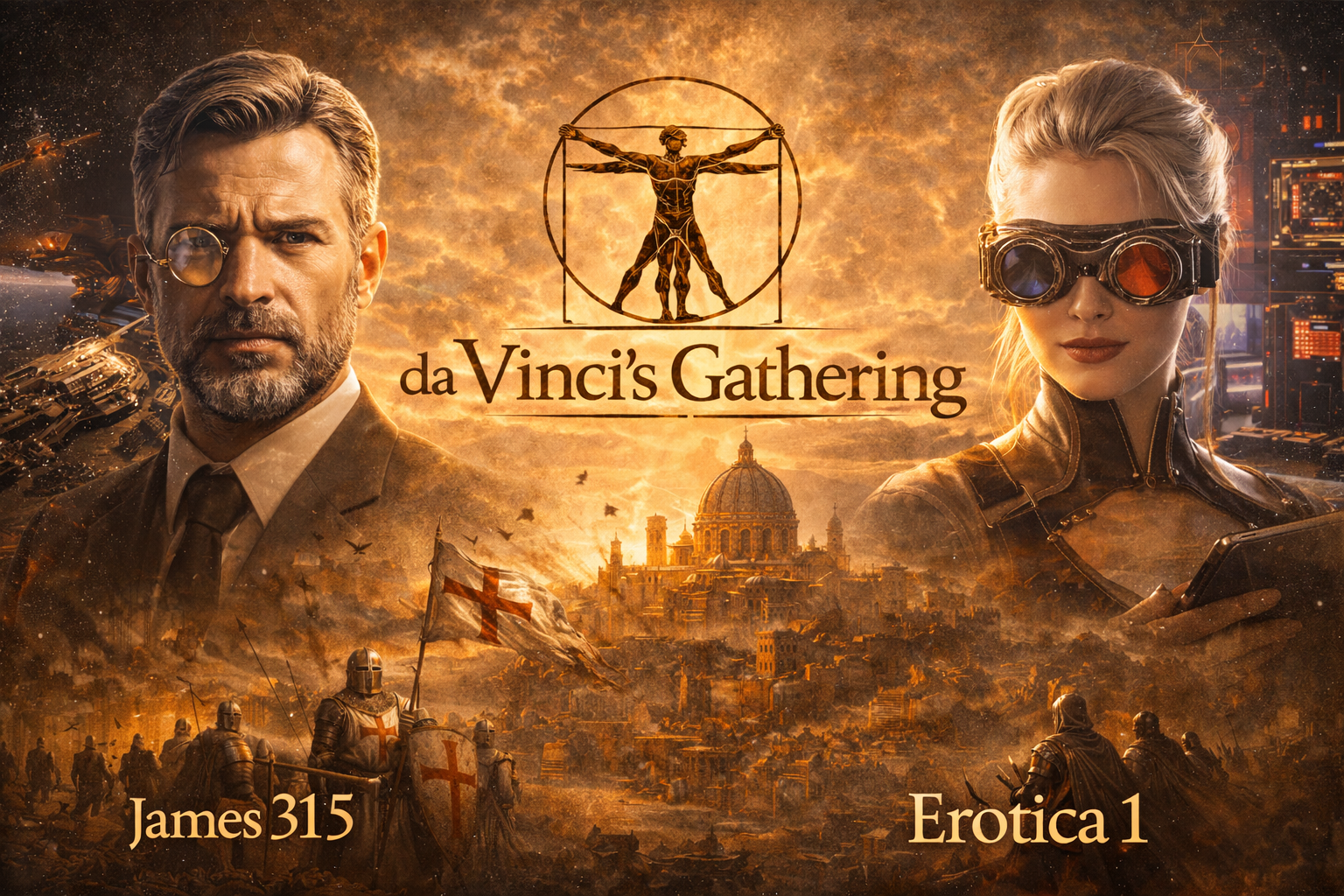
James 315 and the Discovery of the Code

James 315 did not build a community by accident. He identified a vacuum—of standards, of responsibility, of meaning—and stepped into it without asking permission. In the highsec systems of EVE Online, he recognized a familiar pattern: people given powerful tools, operating without discipline, hiding behind mechanics while contributing nothing to the culture they inhabited.

His response was not chaos.
It was structure.

The New Order enforced a simple, controversial idea: behavior matters, even in a sandbox. Rules exist not to restrict freedom, but to create it. And enforcement—clear, visible, unapologetic—is what turns ideals into reality.

James 315 understood something most leaders avoid: that mentorship without standards fails, and standards without enforcement collapse. The New Order became an engine of education, discipline, satire, and pressure—forcing people to confront whether they were participants or merely occupying space.

It was never really about mining.

It was about agency.

Erotica 1 and the Apprenticeship

Every order survives only if its code is transmitted.

Erotica 1 emerged not as a copy of James 315, but as a continuation of the method. Where James established the framework, Erotica tested its limits—stress-testing discipline, authority, performance, and responsibility in an environment that punished weakness and ambiguity.

This was apprenticeship in the old sense: learning not through lectures, but through action. Through friction. Through consequences.

The lesson was not cruelty.
The lesson was clarity.

Systems shape behavior. Incentives matter. People rise—or fail—based on what is tolerated. And leadership is not a title granted by consensus; it is a role assumed through decisive action and consistency.

The code worked because it was enforced.
It mattered because it was real.

The End of One Battlefield

But no code belongs forever to one domain.

EVE Online was a crucible—useful precisely because it stripped away illusions. Yet the lessons learned there were never meant to remain confined to a game. They pointed outward, toward a larger and more consequential terrain: the modern internet itself.

The internet had become highsec.

Endless activity.
Little accountability.
Tools everywhere.
Standards nowhere.

The same pathologies appeared: passive consumption, performative participation, talent left untrained, intelligence wasted. The same need arose—not for louder voices, but for organized seriousness.

A transition became inevitable.

The Emergence of da Vinci

The name da Vinci marks a shift, not a rupture.

It signals expansion.

Leonardo da Vinci represents the ideal that the New Order hinted at but could not fully embody within its original constraints: cross-disciplinary mastery, disciplined curiosity, and creation as obligation. Where the New Order enforced behavior within a system, da Vinci’s Gathering seeks to build systems themselves—cultural, intellectual, economic.

This is not a retreat from rigor.
It is an escalation.

The battlefield is no longer a single game or mechanic. It is the broader culture of online work, creativity, money, and meaning. The tools are no longer ships and bumping mechanics, but writing, software, design, distribution, mentorship, and capital.

The code remains the same.

Standards matter.
Responsibility precedes freedom.
Leadership is exercised, not requested.
Output is the proof.

Continuity, Not Reinvention

da Vinci’s Gathering is not a rejection of the New Order. It is its maturation.

What began as enforcement becomes construction.
What began as satire becomes doctrine.
What began as a test becomes a mission.

The Order of da Vinci’s Knights carries forward the same principles—discipline, mentorship, sponsorship, and enforcement—but applies them to building rather than policing. Knights no longer ask miners to adapt to a system; they build systems worthy of adaptation.

This is the natural progression of any serious movement.

First, order is imposed where none exists.
Then, creation follows.

The New Undertaking

This is the undertaking now underway.

To restore seriousness to creativity.
To train builders instead of audiences.
To enforce standards in an age allergic to them.
To create culture rather than comment on it.

The names have changed because the scope has changed. The medium has changed because the stakes have changed. But the lineage is intact.

The code survives because it works.

And now, it has found a larger world to shape.

This is not the beginning.
It is the continuation.

Welcome to da Vinci’s Gathering.

The Order of da Vinci’s Knights

Every age has its orders.

Not the ones written into law or stamped with authority, but the quieter kind—formed by people who recognize a problem before it has a name, and decide to answer it before they are asked.

The Order of da Vinci’s Knights was born in such a moment.

This is an age of unprecedented power and unprecedented drift. Tools capable of reshaping culture sit in nearly every hand, yet most are used to distract, imitate, or idle. Knowledge is abundant, but wisdom is rare. Creativity is praised, but discipline is avoided. Everyone is encouraged to speak; few are expected to build.

The Order exists because that imbalance cannot be ignored forever.

da Vinci’s Knights are not nostalgic romantics or costume-wearing reenactors of a lost past. They are modern operators who understand an old truth: that progress without standards collapses inward, and freedom without responsibility rots into noise. Where others see chaos as permission to disengage, the Knights see obligation.

They step forward.

The Order takes its name not from a man, but from a model. Leonardo da Vinci was not revered because he was inspired. He was revered because he was relentless—crossing disciplines, mastering fundamentals, and refusing to accept the artificial boundaries of his time. Art, science, engineering, anatomy, warfare, architecture—none were separate domains to him. They were facets of the same pursuit: understanding reality well enough to shape it.

That pursuit defines the Knights.

A Knight of da Vinci’s Order is a builder first. They write, design, code, teach, experiment, and ship. They do not confuse commentary with contribution. They do not outsource judgment to crowds or algorithms. They cultivate taste, train skill, and hold themselves—and others—to standards that outlast trends.

But the Order is not individualistic.

Knights sponsor.
Knights mentor.
Knights enforce the code.

They recognize potential early and sharpen it deliberately. They understand that culture is not improved by consensus, but by example—repeated, visible, and uncompromising. Where standards slip, Knights restore them. Where talent drifts, Knights anchor it. Where noise dominates, Knights bring clarity.

This is not an order of conquest.
It is an order of construction.

The battlefield is cultural. The weapons are craft, discipline, and consistency. The banner is raised not to dominate, but to signal—to those watching quietly from the edges—that seriousness still has a home.

The Order grows slowly by design. Knights are not recruited through persuasion, but through recognition. Output precedes authority. Responsibility precedes belonging. The work comes first. Always.

We are still in the early days. This is the stage before banners are widely recognized, before the language spreads, before the influence becomes obvious. This is the stage where codes are written, standards are set, and the right people find each other without fanfare.

That is how every enduring order begins.

If you are reading this and feel something stir—not excitement, but resolve—then you already understand what this is. The Order does not ask for belief. It asks for participation. It does not promise safety. It promises meaning.

The Renaissance does not return on its own.

It is rebuilt—by those willing to take responsibility for it.

Welcome to the Order of da Vinci’s Knights.

« Older posts Newer posts »

© 2026

Theme by Anders NorenUp ↑