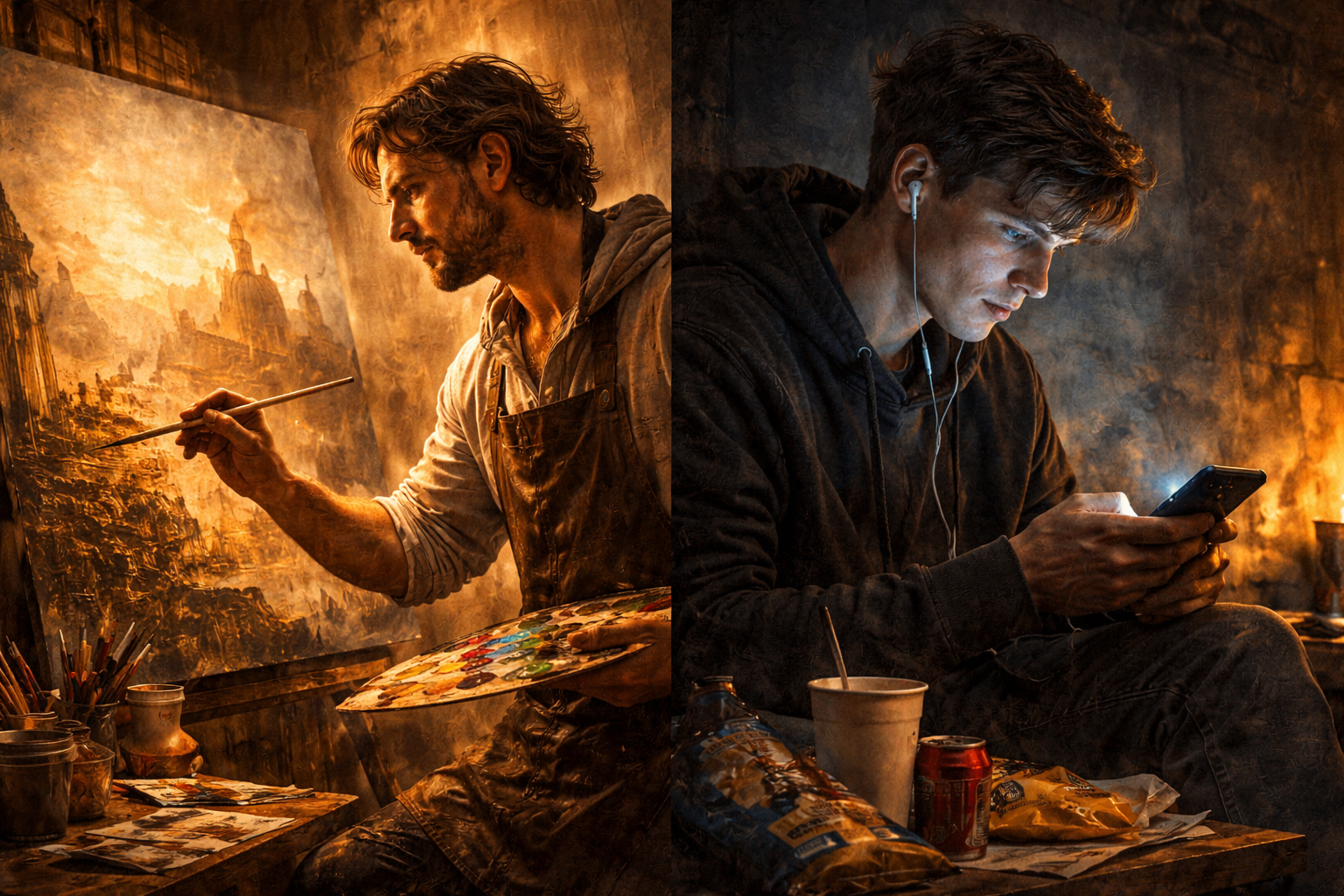
The Line That Divides Everything
Every culture eventually splits in two.
Not by class.
Not by wealth.
Not even by intelligence.
It splits into creators and spectators.
This divide is older than technology, older than institutions, older than the internet—but the modern age has made it impossible to ignore. Never before have so many people had the ability to create, and never before have so many chosen not to.
That choice is the point.
Spectators are not evil. They are not stupid. They are not lazy in the obvious sense. Most are busy, informed, opinionated, and endlessly aware of what others are doing. They read. They watch. They react. They discuss.
But they do not build.
Creators, by contrast, operate under a different internal law. They experience the same distractions, the same doubts, the same access to entertainment and escape—but something interrupts the cycle. An idea nags. A standard pulls. A sense of obligation forms.
Creators feel uncomfortable leaving things unmade.
This is not a personality trait.
It is a posture.
Spectators ask, “What’s happening?”
Creators ask, “What’s missing?”
Spectators measure reality through commentary.
Creators measure it through output.
Spectators wait for permission—social, institutional, or emotional.
Creators assume responsibility and accept the consequences.
The internet promised to turn everyone into a creator. What it actually did was give spectators better seats and louder voices. Likes replaced standards. Visibility replaced craft. Reaction replaced contribution. And slowly, subtly, participation was redefined downward.
Posting became “creating.”
Opinions became “work.”
Consumption became “research.”
The result is a culture rich in awareness and poor in substance.
This is where Orders form.
Historically, when the gap between spectators and creators grows too wide, disciplined minorities emerge to restore balance. Guilds. Academies. Orders. Circles bound not by belief, but by practice.
The Order of da Vinci’s Knights exists precisely at this fault line.
Knights are creators by definition. Not because they are more inspired, but because they are more accountable. They understand that ideas unused decay, that talent untrained rots, and that culture left unattended collapses into noise.
A Knight does not ask whether their work will be noticed.
They ask whether it meets the standard.
They do not confuse audience with authority.
They do not confuse momentum with meaning.
They build first.
They refine second.
They speak last.
This is why the divide matters.
Spectator cultures drift. Creator cultures compound.
Spectators chase relevance.
Creators build infrastructure.
Spectators inherit the future.
Creators design it.
The Gathering does not exist to shame spectators. It exists to offer a crossing. A line in the sand that says: here is where watching ends and responsibility begins.
No one is born on one side permanently. Everyone drifts at times. The difference is who returns to the work.
If this piece unsettles you, that’s a good sign. It means you recognize the tension. The Order does not require perfection—only commitment. Output precedes identity. Work precedes belonging.
This is the choice every serious person must eventually make.
You can observe the Renaissance.
Or you can help build it.
The Knights have already chosen.