On Work, Art, and the Quiet Revolt of Those Who Make Things
Most writers, artists, and creators do not come from comfort.
We come from work.
From long hours. From jobs that left our hands tired and our minds loud. From kitchens, warehouses, call centers, construction sites, night shifts, retail floors, delivery routes, and desks that were never meant to be permanent. We come from lives where stories were not abstract ideas but things that happened to us—often the hard way, often without witnesses.
That is not an accident. It is the source.
The working class has always produced the storytellers because we have something to say. We have lived among consequences. We have learned how systems actually feel when you are inside them. We know what it means to risk something real. Our stories are not imagined from balconies; they are remembered from the ground.
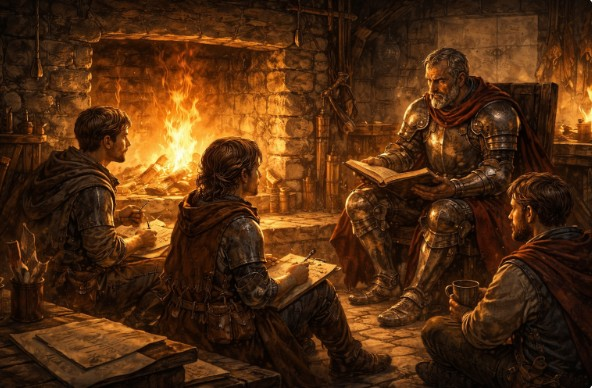
And for centuries, those stories have been gathered up, polished, packaged, and enjoyed by people sitting by warm fires—people who sensed, dimly, that something was missing from their lives.
They read about our adventures because they did not have them.
They read about our struggles because theirs were cushioned.
They read because somewhere inside them, they knew the world was larger than the rooms they inhabited.
This has always been the quiet arrangement.
But the arrangement is changing.
The Old Patronage Model Is Breaking
For most of history, creators needed patrons.
You needed someone with money, land, status, or institutional power to decide your work mattered. To grant you permission. To open a door. To let you sit at the table—usually conditionally, often temporarily.
Even in modern forms, the pattern remained:
- publishers
- studios
- galleries
- academic institutions
- platforms
Gatekeepers replaced nobles, but the logic stayed the same.
You could create—but only if someone else allowed it, funded it, or deemed it acceptable.
The result was predictable:
- stories softened for approval
- voices narrowed for marketability
- risk discouraged
- labor separated from ownership
And yet, the work kept coming from the same place: from people who had lived.
Then the Tools Changed
Artificial intelligence did not create this moment—but it accelerated it.
For the first time, creators who come from work—not wealth—have access to tools that:
- reduce the cost of production
- compress time
- remove technical bottlenecks
- allow iteration at scale
AI does not replace the story.
It replaces the excuses that kept stories locked behind gates.
The machine cannot live a life.
It cannot remember hunger, humiliation, love, loss, or pride.
It cannot carry a body through years and come back with something to say.
But it can help the people who have lived those things build faster, draft deeper, edit cleaner, and distribute wider than ever before.
That is the shift.
Not a replacement of creators—but an expansion of them.
This Is Not a Riot. It Is a Reclaiming.
When we speak of a “workers’ revolt” here, we are not talking about burning buildings or overthrowing governments.
We are talking about something quieter—and more dangerous to the old order.
We are talking about control of narrative returning to those who lived it.
About writers, artists, and creators saying:
- We will own our work.
- We will train each other.
- We will distribute together.
- We will no longer wait for permission to matter.
This is a revolt of standards, not chaos.
Of apprenticeship, not ego.
Of craft, not clout.
It is a refusal to keep giving away the value of lived experience for exposure and crumbs.
Why Apprenticeship Matters Again
For most of history, creators did not emerge alone.
They apprenticed.
They learned alongside others. They sharpened their judgment under watchful eyes. They inherited standards before they broke them. They were shaped—not just encouraged.
Somewhere along the way, the internet told us:
- you must do everything alone
- you must brand yourself immediately
- you must monetize before you understand
- you must shout to be seen
That advice has burned out more creators than it has liberated.
The alternative is older—and better.
Apprenticeship.
Guilds.
Orders.
Workshops.
Places where people who take the work seriously find one another and build skill, reputation, and leverage together.
The Knights Are Not Elites. They Are Stewards.
In da Vinci’s Gathering, the language of Knights is intentional—but misunderstood by some.
A Knight is not someone above others.
A Knight is someone who has committed to:
- learning the craft properly
- protecting standards
- helping others up the path
- carrying knowledge forward
Knights do not hoard tools.
They teach their use.
They do not gatekeep stories.
They help them be told well.
This is how working-class creators stop being extracted from—and start becoming infrastructure.
The New Patron Is the Public—And We Answer Together
Here is the quiet truth the old system never wanted fully realized:
Creators do not need patrons anymore.
We need coordination.
Readers, viewers, listeners, and learners are not scarce. Trust is.
When creators:
- write together
- publish independently
- support one another’s work
- build shared audiences
- and teach the next wave
Something remarkable happens.
The fire moves.
No longer contained in a few houses of wealth, it spreads—controlled, intentional, warming many rooms instead of decorating a few.
Raise the Pen. Lift the Brush.
If you are a writer who has worked for a living, this is about you.
If you are an artist who learned by doing, this is about you.
If you are a creator who feels the weight of lived experience pressing against the limits of old systems, this is about you.
You are not late.
You are not unqualified.
You are not alone.
This is the beginning of a different arrangement—one where the people who lived the stories also build the machines that carry them forward.
Not in chaos.
Not in anger.
But with discipline, apprenticeship, and shared purpose.
The fire has always belonged to the storytellers.
It’s time we gathered around it—together.
If this resonates, you’re welcome to read along with us. Dispatches go out quietly, twice a week, from da Vinci’s Gathering—where creators organize, standards endure, and the work comes first.