Most creators don’t realize what they’ve lost—only that something feels off.
They’re productive. They’re connected. They have tools their heroes could only dream of. And yet, many feel strangely alone while surrounded by noise. Conversations feel shallow. Platforms feel exhausting. Everything feels like it’s happening in public, even when it shouldn’t be.
What’s missing isn’t discipline or ambition.
It’s a place.
What a “Third Place” Used to Be
Sociologists use the term third place to describe the environments that exist outside of home and work. Not private, not professional—social spaces where people show up as themselves.
Historically, these places mattered more than we like to admit.
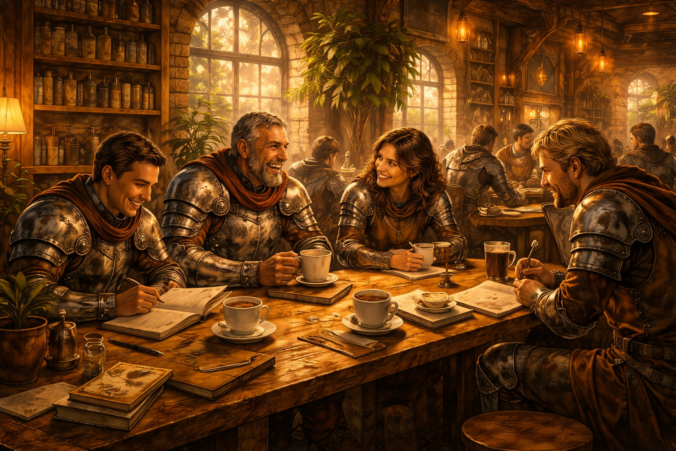
They were cafés where writers argued late into the night. Workshops where apprentices lingered after hours. Guild halls, bars, salons, bookstores, basements, back rooms. Places where ideas circulated before they were polished. Where people tested thoughts without being judged. Where belonging came before performance.
These spaces weren’t optimized. They were alive.
And they shaped culture far more than institutions ever did.
The Internet Promised This—and Then Broke It
Early internet spaces felt like third places.
Forums. IRC. Comment sections that turned into conversations. Small blogs that linked to each other. You didn’t arrive to perform. You arrived to participate.
But as everything scaled, the incentives changed.
Conversation became content. Presence became branding. People stopped talking to one another and started talking at audiences. Algorithms rewarded outrage, speed, and certainty. Nuance slowed you down. Curiosity didn’t convert.
The room collapsed into a stage.
And once that happened, something subtle broke: creators stopped having places where they could be unfinished.
Why Creators Feel Tired Even When They’re “Doing Well”
This is why so many creators feel burned out despite appearing successful.
They’re always “on.”
They’re always visible.
They’re always measurable.
Every idea must justify itself.
Every post must perform.
Every interaction risks becoming transactional.
There’s no safe middle ground anymore—no place to think out loud, to say “I’m not sure,” to joke, to wander, to be human without consequences.
When everything is public, everything becomes brittle.
And brittle systems don’t support creativity for long.
What Happens When You Restore the Room
When creators regain a third place, something interesting happens.
They slow down—not because they’re less serious, but because they’re thinking again. Ideas get better before they get louder. People stop competing for attention and start trading insight. Collaboration happens without scheduling it. Learning becomes social again.
Most importantly, standards rise naturally.
Not because anyone enforces them—but because people don’t want to be sloppy in a room they respect.
This is how culture used to form: not through mass messaging, but through small, dense environments where people influenced one another quietly over time.
Why da Vinci’s Gathering Exists
da Vinci’s Gathering exists to be that missing room.
Not a feed.
Not a funnel.
Not a platform that needs you to perform.
Just a place where creators can hang out, talk honestly, and make better things together.
It’s intentionally anti-niche because real creative lives don’t fit clean categories. Writers talk to coders. Artists learn from founders. Builders borrow language from poets. The overlap is where insight lives.
It’s intentionally calm because panic destroys judgment.
It’s intentionally small enough to feel human.
This Is Not Nostalgia—It’s Infrastructure
This isn’t about going backward.
It’s about rebuilding something essential that modern systems discarded because it didn’t scale cleanly.
Third places don’t scale well.
They don’t monetize easily.
They don’t generate constant metrics.
But they produce something far more valuable: people who think clearly, trust one another, and build things that last.
Every serious creative movement began this way. Not with mass adoption—but with rooms.
An Unforced Invitation
If you’ve been missing a place where:
- you don’t have to perform
- curiosity is rewarded
- conversations feel real
- creativity feels social again
Then you already understand the idea.
da Vinci’s Gathering isn’t trying to replace the internet. It’s trying to give creators a room inside it—one worth staying in.
Come by if you like.
Stay if it fits.
Leave if it doesn’t.
The room will still be here.